

5 Spanish Translation Mistakes That Cause Workplace Safety Issues
Published
When a Spanish Translation Mistake Becomes a Safety Incident
On a job site, a translation mistake is rarely just an awkward sentence. It is a worker who restarts a machine that was supposed to stay off, a spotter who stands in the wrong place, a crew that reads “secure the load” as “the load is secure.” The gap between what a supervisor meant and what a Spanish-speaking worker understood is exactly where incidents happen.
This is not a small-numbers problem. Industry estimates put the cost of workplace injuries in the United States at over $176 billion a year — roughly $1,080 for every worker. A meaningful share of that exposure traces back to instructions that were given clearly in one language and received unclearly in another.
The encouraging part: the most damaging Spanish translation mistakes are predictable. They repeat across construction sites, factory floors, warehouses, hotels, and farms. Once you can name them, you can design them out of your daily communication. Below are the five that cause the most safety trouble — and a concrete fix for each. For the wider picture on Spanish translation in team chat, start with our complete guide to Spanish translation in LINE.
Mistake 1: Trusting Word-for-Word Machine Translation for Safety Instructions
The fastest way to get a Spanish translation wrong is to translate the words instead of the meaning. General-purpose machine translation is built for fluency, not for safety-critical precision, and it has no idea which sentence is a casual aside and which one will get someone hurt.
Safety language is full of terms that break under literal translation. “Lock out the press before you clear the jam” is a specific procedure — isolate the energy source, apply a lock, verify it is dead. Translated word-for-word, “lock out” can land as simply turning the machine off, and the verification step quietly disappears. Idioms fail the same way: “watch your step,” “stay on top of it,” and “tie it off” all produce Spanish that is grammatically fine and operationally wrong.
The danger is that the output looks confident. A worker reads a clean Spanish sentence, assumes it is correct, and acts on it. There is no spellcheck-style underline for “this instruction lost its meaning.”
The fix: Treat safety-critical instructions as their own category. Use a translator that works from context and meaning rather than dictionary substitution, and pair any procedure term with a plain-language description the first time it appears — “lockout/tagout (lock the machine’s power off and confirm it cannot start).” Have a bilingual team member spot-check the handful of instructions that carry real risk. You do not need to verify every message; you need to verify the ones that would hurt someone if misread.
Mistake 2: Treating “Spanish” as One Single Language
“We translated it into Spanish” sounds like a finished job. It is not, because there is no single Spanish. A crew can include workers from Mexico, Guatemala, Honduras, El Salvador, the Dominican Republic, Colombia, and beyond — and everyday workplace vocabulary shifts across all of them.
The same tool, vehicle, or piece of equipment often has three different common names across one crew. More dangerous are the words that sound certain but are not. “Ahorita” is the classic example: depending on where a worker grew up, “ahorita lo hago” can mean “I’ll do it this second” or “I’ll get to it eventually.” On a safety instruction with a deadline — clear the area, shut the valve, move the load — that ambiguity is the whole risk.
When a company picks one regional translation and assumes it reads cleanly for everyone, part of the crew silently fills the gaps with guesses. Nobody asks, because asking feels like admitting they did not understand.
The fix: Stop treating translation as one-directional broadcast. Let workers reply in their own words so you actually hear the vocabulary they use, and confirm understanding instead of assuming it — “tell me what you’re about to do” beats “got it?” Build a short shared glossary of the ten or fifteen terms that matter most on your site, agreed with the actual crew. And use a translator that adapts to natural, conversational Spanish from any region rather than one frozen dialect.
Mistake 3: Translating the Words but Dropping the Urgency
A safety instruction carries two things: information and urgency. Most translation effort protects the first and quietly loses the second.
“Stop the line now — do not restart it” can come out the other side as something closer to “it would be good to pause the line.” The facts survive; the force does not. This happens because polite, hedged phrasing is the default register for most translation output, and Spanish gives a translator real choices — a direct command versus a softened request, formal versus informal address — that change how hard an instruction lands. Pick the gentle option for a stop-work order and the worker hears a suggestion.
The urgency is not decoration. It is the part of the message that determines whether someone acts in the next five seconds or the next five minutes. For a hydraulic leak, a live electrical fault, or a suspended load, that difference is the incident.
The fix: Keep safety-critical messages short, literal, and imperative — “Stop. Do not restart press 2.” A blunt sentence is far easier to translate without losing its edge than a polite paragraph. Mark genuinely urgent messages so they read as urgent in both languages, with a clear tag like “URGENT / URGENTE.” And use a translator that preserves register — one that renders a command as a command — so a stop-work order never arrives sounding optional.
Mistake 4: Translating the Signage but Not the Conversation
Plenty of companies have done real work on safety translation. The warning signs are bilingual. The handbook is bilingual. The safety data sheets are in the binder in both languages. Then an incident happens anyway — and the reason is almost always the same.
Signs and handbooks are the static layer. They cover the hazards you already knew about when you printed them. But most of the day’s actual safety communication is live: the shift handover, “the guard on press 3 is loose,” “we’re a spotter short on the east bay,” “skip the third rack, it’s not braced yet.” That live coordination happens in conversation and group chat — and it is overwhelmingly English-only.
So the crew gets a perfectly translated poster about a hazard from last year, and an English-only message about the hazard that appeared twenty minutes ago. The gap between the static layer and the live layer is where Spanish-speaking workers fall out of the safety conversation.
The fix: Translate the live channel, not just the printed one. The group chat where your crew actually coordinates the shift is a safety system, whether you treat it as one or not. When a hazard called out at 10:00 a.m. reaches every worker in their own language within seconds — instead of waiting for the next toolbox talk — the static and live layers finally match.
Mistake 5: Relying on One Bilingual Worker to Relay Everything
Almost every mixed-language crew has a “go-to” — one bilingual worker who ends up relaying instructions, translating warnings, and fielding questions for everyone else. It feels efficient. It is one of the most fragile safety arrangements you can build.
Start with availability. That worker takes breaks, works a different shift, calls in sick, goes on leave, and eventually moves on. Every hour they are not on the floor, the translation channel is dark — and hazards do not wait for the interpreter to clock in. Then there is drift: a busy worker relaying a message under time pressure compresses it, softens it, or simply forgets a clause. They are not a trained interpreter, and safety-critical detail is precisely what gets lost when someone is paraphrasing on the move.
It is also unfair. You have handed one person informal responsibility for whether their coworkers understand safety instructions, with none of the support a real interpreter role would carry. And because the relay is verbal, there is no record. When a review asks “was the crew told the rack wasn’t braced?”, the honest answer is “probably, through someone, at some point.”
The fix: Never let safety communication depend on one person being in the room. Give every worker direct access to translated messages, so the instruction reaches them whether or not the bilingual coworker is on shift. And keep the exchange in writing — a timestamped thread that shows what was communicated, to whom, and when, is worth far more than a memory of a hallway conversation.
How to Close These Five Gaps in Your LINE Group
Every fix above points in the same direction: translation has to live inside the channel your crew already uses to coordinate work — not in a separate app, a printed binder, or one person’s head. For teams that run their day in LINE group chats, that is exactly what an in-chat translation bot does.
Echonora is a translation bot that sits inside your LINE group. Add it to the chat, send one activation command — @Echonora english and spanish — and from that point every message is translated both directions automatically. The supervisor types an instruction in English; the Spanish-speaking crew reads it in Spanish. A worker replies in Spanish; the supervisor reads it in English. Nobody copies, pastes, switches apps, or waits for a relay.
Here is what an urgent instruction looks like when it reaches the crew directly, in their own language, the moment it is sent:
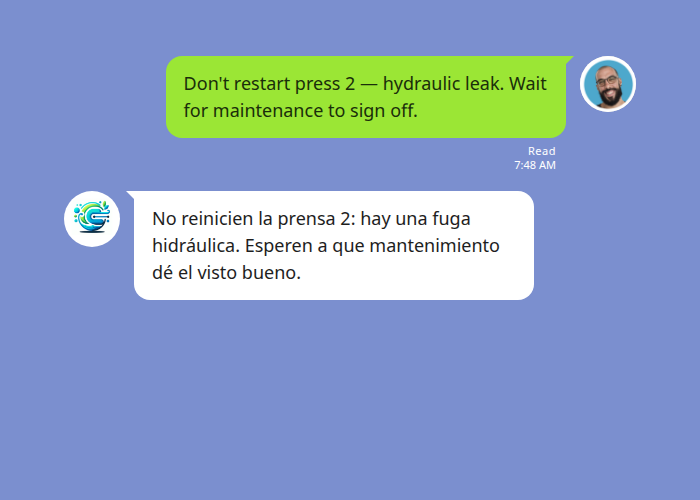
An urgent safety instruction reaches the Spanish-speaking crew directly, in their own language, the moment it is sent.
That covers Mistakes 3 and 5 at once — the command keeps its force, and it reaches every worker without routing through a single bilingual coworker. It also addresses Mistake 4: this is the live channel, translated. Because the bot also handles voice messages, a worker whose hands are full can report a hazard by voice note, and the bot transcribes and translates it for everyone:
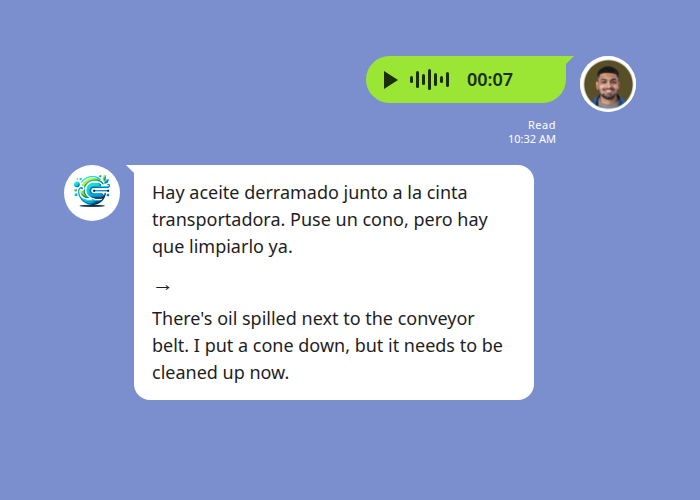
A Spanish-speaking worker reports a spill hazard by voice note; Echonora transcribes and translates it for the whole group.
The bot’s reply is text — it shows the transcribed Spanish above the arrow and the English translation below — so the report is searchable and reviewable later, not just heard once. For more on that workflow, see our guide to translating Spanish voice messages in LINE. The full chat thread becomes a timestamped record of what was communicated and when — the audit trail that a verbal relay never leaves behind. Echonora supports 180+ languages, so the same group can add a third language later with one command; see the supported languages and activation syntax reference for every pair.
One honest limit. In-chat translation is the daily-conversation layer — shift coordination, hazard call-outs, quick instructions, the back-and-forth that quietly turns into incidents when it is lost. It is not a substitute for a formal safety program. Certified safety training, official incident documentation, and any legally required records still call for professional interpreters and translators. What an in-chat translator fixes is the everyday gap — the dozens of small operational messages a day that never reach half the crew.
Start Using Echonora — Break Language Barriers
Translate every safety message in your LINE group automatically — English and Spanish, text and voice. 180+ languages, free plan, no credit card.
Frequently Asked Questions
Can a translation bot replace a professional safety interpreter?
No, and it should not try to. A professional interpreter is the right call for formal safety training, certified incident documentation, and any legally required records. An in-chat translation bot handles the daily operational layer — shift handovers, hazard call-outs, quick instructions — that a professional interpreter is never on hand for. The two solve different problems; the bot closes the everyday gap, not the formal one.
How do workers report a hazard if their hands are full and they can’t type?
They send a voice note. Echonora transcribes the Spanish voice message and posts the English translation as a text bubble in the group, so a worker wearing gloves or holding a tool can still report a spill or a fault hands-free. The full walkthrough is in our Spanish voice message translation guide.
We already translated our safety signs and handbook — isn’t that enough?
Translated signage and handbooks are necessary, but they only cover the static layer — the hazards you knew about in advance. Most safety communication is live: today’s shift handover, the fault someone spotted an hour ago, the rack that isn’t braced yet. If that live conversation is English-only, Spanish-speaking workers are missing the most current information. Translating the group chat closes that gap.
Our crew speaks several kinds of Spanish — will one translation work for everyone?
Echonora translates conversational meaning rather than swapping in one frozen regional dictionary, and it handles natural Spanish from any region. Just as importantly, because every worker can reply in their own words, you hear the vocabulary the crew actually uses — which makes it easy to confirm understanding rather than assume it. For the terms that carry real risk, agree a short shared glossary with the crew.
Is there a free way to try this before rolling it out to the whole team?
Yes. Echonora’s free plan covers 20 translated messages a day, with no credit card and no expiry. That is enough to add the bot to one crew’s LINE group, run it through a few real shifts, and see whether it closes the gaps before you decide on a paid plan for daily traffic.
Where do the messages go — is the group chat private?
Messages stay in the LINE group with the people you invited; Echonora processes them to deliver the translation and posts the result back into the same thread. See the privacy policy for full data-handling details.
Make Every Safety Message Land in Both Languages
The five mistakes above share one root cause: safety communication that works in one language and degrades on the way to the other. Fixing it does not require a new safety program — it requires the daily conversation to be legible to everyone on the crew, in real time. Add Echonora to your team’s LINE group, and every instruction, hazard report, and shift handover reaches every worker in the language they think in.
Start Using Echonora — Break Language Barriers
Real-time English ⇄ Spanish translation inside your LINE group — text and voice. 180+ languages supported.