

LINE Spanish Translation for Agriculture: Managing Seasonal Farm Workers
Published
It is 6:30 in the morning at a stone-fruit orchard. The crew leader has a mixed team waiting at the north gate: some read English, most read Spanish first. He has about five minutes to hand out block assignments, flag that Block 7 was sprayed yesterday, and remind everyone where the water and shade are before the heat climbs. On a farm, the gap between “I said it” and “everyone understood it” is measured in rework, spoiled fruit, and — on a sprayed block or a hot afternoon — in safety.
Spanish is the first language of a large share of the seasonal agricultural workforce, yet most farm coordination still happens in fast, spoken English or in a group chat nobody re-reads. This is a guide to closing that gap directly inside the LINE group your crew already uses — so a task assignment, a safety briefing, or a schedule change lands in Spanish and in English at the same time, with a record you can check later.
Where Spanish–English gaps cost the farm
The cost of a miscommunication in agriculture is rarely the words themselves — it is the latency and the rework that follow. Three cost vectors show up again and again:
- Rework and waste. A row picked too early, the wrong block cleared, ripe fruit left because “leave the green ones” was heard as “leave them.” Each is a half-day of labour that has to be redone, plus the crop that does not come back.
- Schedule slippage. Weather windows in agriculture are short. When a start-time change or a “move to Block 5 today” does not reach half the crew, the whole day slips behind the window.
- Safety and compliance risk. Pesticide re-entry intervals, heat-illness breaks, and equipment warnings are exactly the messages that must not get lost in translation. A worker who does not read the re-entry notice is a worker on a block they should not be on.
The usual workaround — a bilingual crew leader relaying everything by voice — puts one person on the critical path for every instruction. When that person is at the far end of the field, the message waits. The point of putting translation into the chat is to take that one person off the critical path without losing the record of what was said.
How Echonora runs in a farm crew’s LINE group
Echonora is a translation bot that lives inside a normal LINE group — the same app most crews already use to coordinate. There is no separate worker app to install and no new account for anyone to onboard. You add the bot to the group, name the languages once, and from then on every message posts in each configured language in the same thread.
Setup is a single message. In an English-and-Spanish crew group, one person types:
@Echonora english and spanishFrom that point, when the crew leader writes in English, the Spanish reads alongside it; when a worker replies in Spanish, the English appears for the leader. You use language names, not codes — and a group can run 2 to 5 languages at once, which matters on farms that also run Mixteco-, Punjabi-, or Thai-speaking crews alongside Spanish. See the full list of supported languages and exact activation syntax for every pair.
Voice matters in the field. A crew leader with dirty gloves and a clipboard is not going to type a paragraph. Echonora translates LINE voice messages the same way it handles text: the voice note is transcribed, then translated, and the bot posts the text — original above, translation below — usually within a few seconds. The worker’s original recording stays in the thread; the bot adds the readable translation next to it. One caution honest to the setting: heavy background noise — a running tractor, wind, a packing line — can degrade voice transcription, so for a critical re-entry or safety notice it is worth recording somewhere quieter or following up in text.
Scenario: the morning block assignment
The most repeated message on any farm is “who is where, doing what.” When it is bilingual and instant, the crew starts the right work on the first try instead of the second.
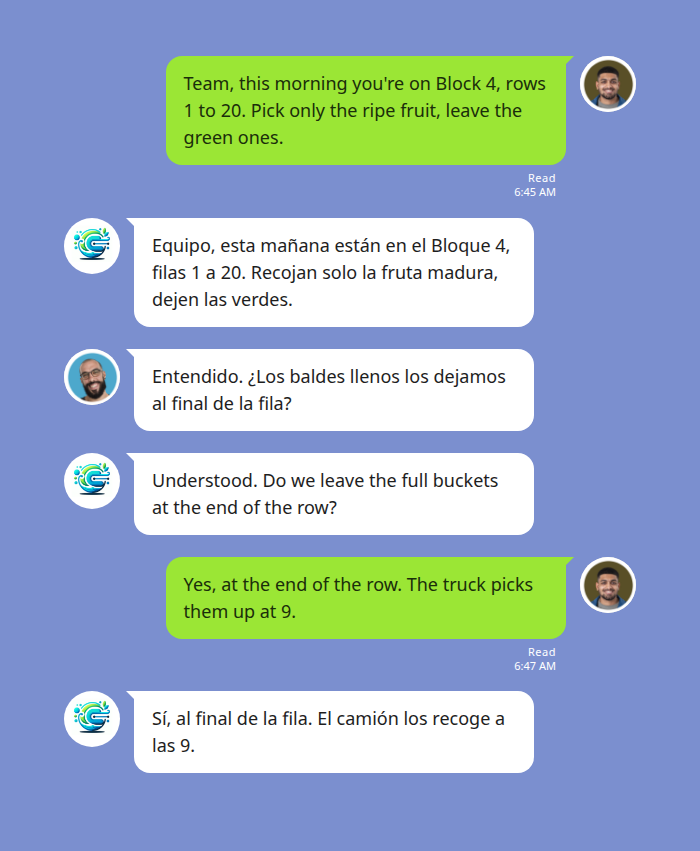
The crew leader assigns Block 4, rows 1 to 20, and specifies ripe-only picking — in English. The Spanish posts immediately below. The worker’s clarifying question (“do we leave the full buckets at the end of the row?”) comes back in Spanish and the leader reads it in English, answers once, and the whole crew has the same instruction at the same time. Nobody waited for a relay, and the thread now holds the assignment if a question comes up at 9 when the truck arrives.
Scenario: the safety briefing and pesticide re-entry
Safety is the message you least want to leave to a hurried gesture across a field. Re-entry intervals, heat breaks, and equipment cautions are also the messages a crew leader is most likely to send by voice — hands full, moving between blocks.
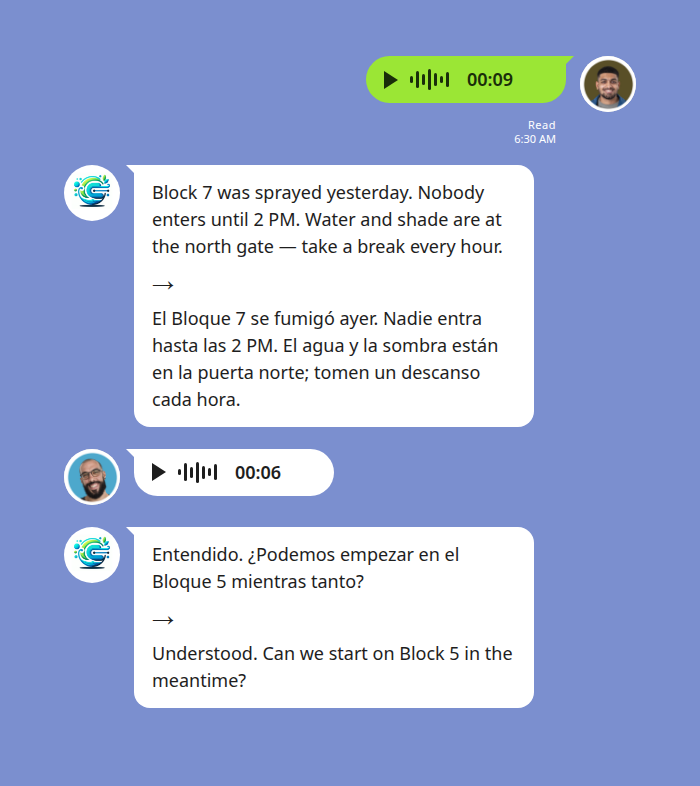
The crew leader voice-notes that Block 7 was sprayed yesterday, nobody enters until 2 PM, and water and shade are at the north gate with a break every hour. Echonora posts the transcript in English and the translation in Spanish. The worker voice-notes back in Spanish — can they start on Block 5 in the meantime — and the leader reads the English. The re-entry time is now written down in both languages in the group, which is exactly the kind of instruction you want as a record rather than a memory.
Scenario: weather, schedule changes, and piece-rate clarity
Agriculture runs on last-minute changes: rain moves the start time, a block ripens early, a truck is late. These are the messages most likely to reach only the workers standing next to the leader. Posted once in the group, a “we start at 7 not 6:30 because of the frost” reaches everyone in their own language at the same moment.
Piece-rate and pay questions are a second place clarity pays for itself. When a worker can ask “is this rate per bucket or per bin?” in Spanish and get a plain answer in Spanish — with the exchange visible in the thread — the question gets asked instead of guessed at, and the answer is on record if it comes up on payday. Written clarity here is a form of respect as much as efficiency; workers who can ask questions in their first language ask more of them, and the crew makes fewer silent mistakes. For teams handling more sensitive personal or contract topics, note that messages are processed to deliver the translation and stay in your LINE thread — see the privacy policy for data-handling specifics.
Echonora vs. the tools crews already reach for
Most farm teams already translate somehow — usually a bilingual leader, a translation app, or a phone’s built-in translator. Here is how the in-chat approach compares on the things that matter in the field.
| Google Translate | WhatsApp translation | Echonora on LINE | |
|---|---|---|---|
| Where it works | Separate app — copy, paste, paste back | Inside WhatsApp chats | Inside the LINE group the crew already uses |
| Group visibility | None — each person translates privately | Each phone shows its own private translation | One shared thread everyone reads in their own language |
| Voice messages | Manual, outside the chat | Text-focused | Voice notes transcribed and translated in the thread |
| Record you can re-check | None — copy-paste loses it | Private per device | Persistent group thread — the assignment or safety notice stays put |
The difference that counts on a farm is shared visibility: a private translation on the leader’s phone does not help the picker three rows over. A shared thread does, and it doubles as the record when the morning review asks who knew what, when. This cluster sits under our broader complete guide to Spanish translation on LINE; if your crews run more than one first language, the generic farm crew translation guide for seasonal workers covers the multilingual case.
Start Using Echonora — Break Language Barriers
180+ languages, real-time text and voice translation right inside your crew’s LINE group
Getting started with your crew
You can validate this on one crew before rolling it out across the operation:
- Add the bot. Open the add-on-LINE link and invite Echonora into your existing crew group.
- Name the languages once. Type
@Echonora english and spanishin the group. The bot confirms and starts translating. - Run a real morning on it. Use it for one day of block assignments and one safety briefing. That is enough to see whether the crew starts the right work the first time.
The free plan covers 20 messages a day with no credit card and no expiry — enough to prove it out on a single crew. When daily volume grows across multiple crews or blocks, the paid plan removes the ceiling; pricing is on echonora.com. Because the benefit extends to every group a paid member is in, farms usually arrange accounts by crew leader or site rather than per worker.
Frequently asked questions
Do the workers need to install anything or make an account?
No. If your crew already uses LINE, you add the bot to the existing group and name the languages once. There is no separate app and no new account for workers to set up.
Does it handle voice notes, not just typed messages?
Yes. LINE voice messages are transcribed and translated in the same thread, usually within a few seconds. Loud background noise can reduce transcription accuracy, so for critical safety or re-entry instructions it helps to record somewhere quieter or add a short text follow-up.
Can one group run more than two languages?
Yes — a single group supports 2 to 5 languages at once. A crew that mixes Spanish with, say, Mixteco or Punjabi speakers can run all of them in one thread, with each message posting in every configured language.
Is there a record we can check later?
Yes. Everything stays in the LINE group thread, so a block assignment, a schedule change, or a pesticide re-entry notice can be re-read afterward — useful when a question comes up on payday or during a safety review.
How much does it cost?
There is a permanent free plan (20 messages a day, no credit card, no expiry) to validate it on one crew, and paid plans for unlimited translation across your groups. Current pricing is on echonora.com.
Bring your Spanish-speaking crew into the same conversation
Add Echonora to your LINE group and translate task assignments, safety briefings, and schedules in real time