

Ligo Translator vs Echonora: Which LINE Bot Fits Your Group
Published · Last reviewed
This comparison is published by Echonora. We have set out the differences as factually as we can, so you can decide which option suits your situation.
Features and pricing change over time. Check the provider's own site for the current position.
If you have gone looking for a translator bot for LINE, you have probably found Ligo. It is a real product, it has been around a while, and for a lot of people it does the job. Echonora does the same job a different way.
Check anything that matters to you on Ligo’s own site before you decide. What follows is what each bot actually does, where they genuinely differ, and which kind of group each one suits.
What the two bots have in common
More than the marketing on either side suggests. Both are bots you add to LINE as a friend and then invite into a group. Both translate messages in the group automatically once you have set the languages, so nobody has to copy anything into a separate app. And because a bot posts into the thread like any other member, the translation is a message everyone in the group sees — which is not how LINE’s own per-pair translation behaves, where each person sees their own local version and nothing persists in the conversation for anyone else to read back.
Both also handle more than two languages in one group. Ligo’s setup takes between two and five language codes; Echonora works the same way, with the same ceiling of five languages in a single group.
So the choice is not “which one translates”. It is a handful of narrower differences that matter a lot to some groups and not at all to others.
Language coverage
Ligo’s site claims 100+ languages and publishes its list. Echonora publishes its own list, which runs to over 180. Those are each company’s own figure, and the two are not counted the same way — so look your own pair up on both lists rather than reading anything into the totals.
In practice this only decides anything at the edges. For the common LINE pairs — Thai, Japanese, Chinese, Korean, Vietnamese, Indonesian, English — both bots cover you, and the total count is a number that looks decisive and rarely is. Look your own pair up on both sides rather than comparing headline figures.
The free plans work differently, and it is the real difference
This is the point most comparisons skip, and it is the one that will decide which bot you are still using in three months.
Ligo’s free quota is 5,000 characters, and its site says it never expires. That is a one-off allowance: you get it once, it sits there until you use it, and when it is gone it is gone unless you pay.
Echonora’s free plan works the other way round. There is a fixed cap on how many messages it translates in a day, and it resets the next day, every day, permanently. Being a free plan, it needs no credit card and has no expiry date — but when you hit the daily cap, translation stops until the reset.
Neither model is better in the abstract; they suit different patterns of use:
- A trip, a one-off negotiation, an occasional message to a supplier — a fixed character allowance that never expires is genuinely useful. You are not going to burn through it, and you may never pay anything.
- A group that talks every day — a lifetime character allowance disappears fast, and once it does the bot is silent until you pay. A daily allowance that comes back tomorrow keeps a low-volume group working indefinitely for nothing.
Work out which of those describes your group before you look at anything else on this page.
Voice messages
If people in your group send voice notes, this is where the two diverge sharply.
Echonora handles LINE voice messages: the note is transcribed first, then translated, and the result comes back as text in the thread. Your original voice note stays where it was. Ligo’s site documents text translation and does not describe voice-message handling, so if voice notes are part of how your group actually talks, check that directly with Ligo before assuming it is covered.
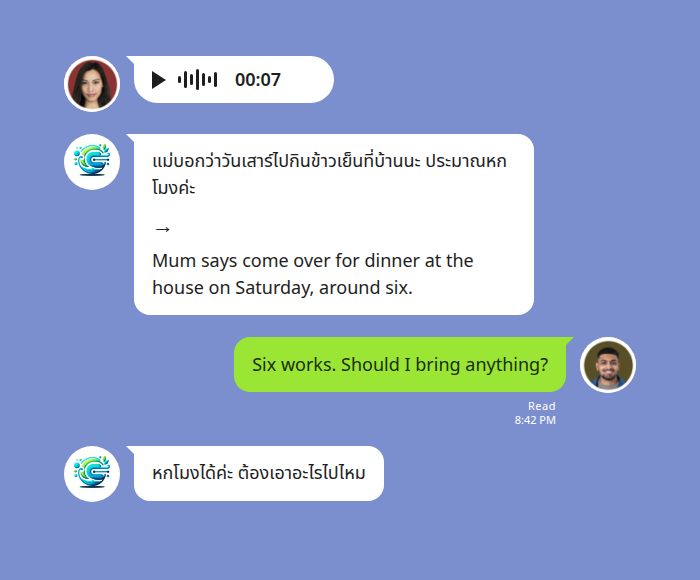
Worth being precise about what this is and is not. The bot’s reply is always text — it transcribes and translates a voice note, it does not talk back. And it is voice messages specifically, not calls: a LINE voice or video call is not translated by either bot.
Setting each one up in a group
The shape is the same for both: add the bot as a friend, invite it into the group, then send one command in that group telling it which languages to work between.
For Echonora that command is @Echonora english and thai, and it holds from then on. A third language is added the same way — @Echonora english and thai and japanese — up to five in the one group.
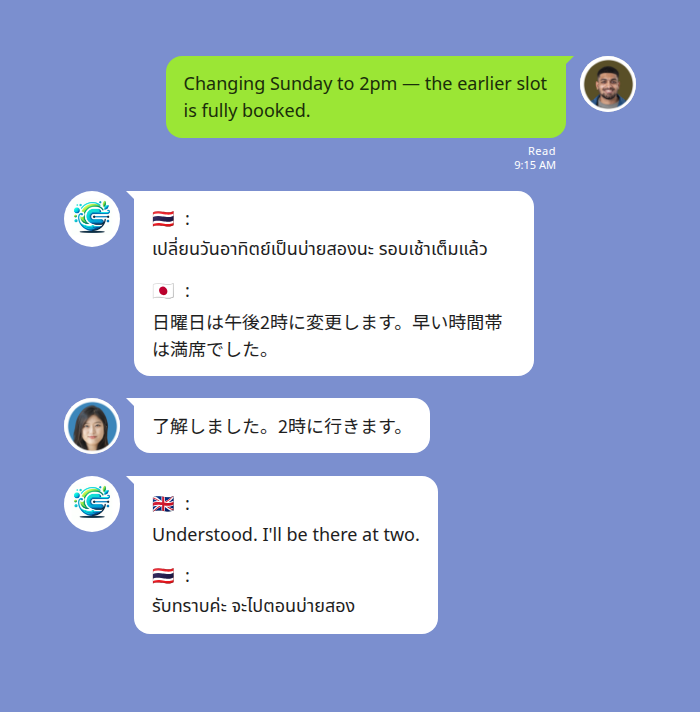
Two things about Echonora that catch people out, and are worth checking on Ligo’s side too:
- It works inside groups, not in a one-to-one chat with the bot. Messaging the bot privately will not translate a conversation. If you are working on your own, put the bot in a group by itself — a group of one still translates.
- Text inside images and screenshots is not read. Echonora does not translate text inside images, and Ligo’s site does not mention image translation either — though not mentioning it is not the same as ruling it out, so check with Ligo if you need it. If it matters, send it as text.
You can only run one bot in a group at a time
Ligo’s own site notes that LINE allows one bot in a given group at a time. We have not tested that ourselves, but taking it at face value it has a practical consequence worth knowing before you start: you cannot run both in the same group and compare them side by side on the same conversation.
What you can do is set up a second group — with the same people, or with just yourself — and run the other bot there for a few days. That gets you a real comparison on your own languages and your own way of writing, which is worth considerably more than anyone’s feature table, including this one.
Price
Ligo publishes its pricing in Thai baht: ฿59.00 THB a month, or ฿169 THB for three months, which works out at roughly US$1.89 and US$5.19 respectively at the rates quoted on its site. Ligo Corporation gives a Bangkok address in that site’s footer, which is why it prices in baht.
Echonora’s paid plans are a flat monthly or annual fee that removes the daily cap and gives unlimited message translation across every group you are in, with the annual option costing less per month than the monthly one. To see the current figure and subscribe, message @Echonora in LINE and the bot sends back your own checkout link — the subscription has to be bound to your LINE account, which is why it goes through the bot rather than a page on a website.
Put plainly, so you are not surprised later: on headline monthly price Ligo costs less. What Echonora’s fee buys is the unlimited tier and the voice handling, and whether that is worth the difference depends entirely on how much your group actually talks.
One detail that applies to Echonora and is easy to misread: the subscription belongs to a person, not to a group. If any one member of a group is on a paid plan, the whole group gets unlimited translation and nobody else needs their own. If that member later leaves the group, the group falls back to whatever plan the remaining members have — the free daily cap, if none of them is paying.
Start Using Echonora — Break Language Barriers
Which one fits your group
| Your situation | The better fit |
|---|---|
| Occasional use — a trip, a one-off deal, a few messages a month | Ligo. A character allowance that never expires suits low, irregular volume, and you may never pay. |
| Lowest possible monthly cost, text only | Ligo, on published prices. |
| A group that talks daily and wants to stay on a free plan | Echonora. A daily allowance that resets beats a one-off allowance that runs out. |
| Voice notes are part of how the group talks | Echonora. Ligo does not document voice-message handling. |
| High daily volume, several languages, want it to just work | Echonora’s unlimited paid tier. |
| A language pair outside the common LINE ones | Check both lists. Neither headline count settles it. |
If you are still unsure after that, the honest answer is that a few days of real use will tell you more than this table will. Both bots are free to start with.
Before you commit to either
Set up a small group, add one bot, and send it the kind of messages your group actually sends — the short ones, the slangy ones, the voice notes if you use them. Then do the same with the other in a second group. What separates these two products in daily use is not the feature list; it is how each one handles the way your particular group writes, and that is not something you can read off a page.
For the wider question of what LINE does and does not translate on its own, before any bot is involved, see does LINE have a translator. If voice notes are the main thing you need covered, LINE voice message translation goes into how transcription and translation work together, and LINE Thai to English translation covers the single most common pair among English-speaking LINE users.