

Workplace Safety Compliance: Translating Safety Briefings and SOPs for Foreign Workers
Published
It’s 06:48 on a precast-concrete yard. The shift supervisor has four minutes to brief eleven incoming operators before the first pour — three Vietnamese, two Indonesian, a Thai rigger, the rest local. The hazard today is a new scaffold run along the east wall. He says the words. Heads nod. And nodding is exactly the problem: a nod is what a worker gives when they don’t want to look like they didn’t follow, not proof that they did.
Safety is the one area where “they probably got it” is not an acceptable margin. A mistranslated torque spec costs a part. A mistranslated fall-protection instruction costs a person. Yet the safety briefing is still, on most multilingual sites, delivered once, verbally, in a single language, with no record that it landed.
This is the gap between having a safety program and having a safety program your whole crew can actually read.
Why multilingual safety briefings break down
US workplace-safety expectations are unambiguous on one point: safety training has to be delivered in a manner — a language and a vocabulary — that workers genuinely understand. Posting an English SOP on a noticeboard does not meet that bar if a third of the crew reads Vietnamese or Indonesian first.
In practice, sites bridge the gap three ways, and all three leak:
- A bilingual lead interprets on the fly. Fast, but unrecorded and inconsistent. When the lead is on annual leave or pulled to another line, the translation layer disappears with them.
- Printed multilingual safety sheets. Better for static rules, useless for today’s specific hazard. The new scaffold run, the chemical delivery that arrived an hour ago, the crane lift rescheduled to the afternoon — none of that is on a laminated sheet.
- A translation app, copy-pasted. Someone screenshots the briefing, pastes it into a separate app, pastes the result back. It works for one message and collapses the moment the pace picks up.
The common failure is that safety information is perishable and specific, but the translation methods are either generic or manual. The briefing that matters is the one about this shift, and it has to reach every worker before the work starts — not after the incident.
What “translated safety” actually has to cover
A workable multilingual safety setup isn’t just the morning toolbox talk. Four artifacts need to cross the language line reliably:
- Daily briefings / toolbox talks — today’s hazard, today’s exclusion zone, today’s permit-to-work conditions.
- Standard operating procedures (SOPs) — the repeatable steps, including the conditional ones (“if the wind picks up above the threshold, stop the lift”) that lose their condition in a sloppy translation.
- Incident and near-miss reports — where the worker who saw it is often the one least able to write it up in the site’s primary language.
- Acknowledgement — a record that the instruction was not just sent but received, in a language the worker reads.
The fourth is the one most systems skip, and it’s the one a compliance review asks about first: can you show that the worker understood the safety instruction?
Put the translation where the crew already is
Most foreign workers are already in a LINE group with their crew, their lead, and often their agency. That existing group is the highest-leverage place to put safety translation, because it requires zero new app, zero new login, and zero onboarding.
Echonora is a translation bot that lives inside that LINE group. Invite it once, set the languages with a plain command — for an English-plus-Vietnamese crew, @Echonora english and vietnamese — and from then on every message a worker or supervisor posts is translated for everyone in the group, in the same thread, automatically. It supports 180+ languages and 2 to 5 languages in a single group, so a mixed Vietnamese / Indonesian / Thai crew all read the same briefing in their own first language.
Two properties make it fit safety specifically:
- Voice briefings translate too. A supervisor with gloves on can voice-note the morning hazard instead of typing it. The bot transcribes the audio and posts the translation in text, typically in 3–8 seconds — conversational pace. The worker reads the instruction; the original voice note stays in the thread.
- The thread is the record. Because the translation happens in the group, the briefing and its translation both persist. When the morning review asks who was told what, the answer is in the chat — not in someone’s memory.
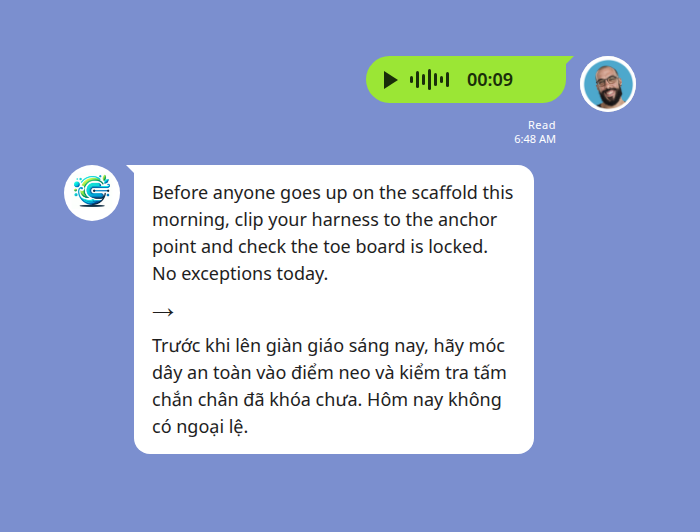
A 9-second voice briefing from the supervisor, transcribed and translated in the group thread. The instruction — clip the harness, check the toe board — reaches the Vietnamese rigger in his own language before he’s on the scaffold.
How it compares to the usual fixes
| Verbal-only briefing | Printed multilingual sheets | Echonora in the LINE group | |
|---|---|---|---|
| Covers today’s specific hazard | Yes, but unrecorded | No — static only | Yes, in the thread |
| Reaches each worker in their language | Only if a lead interprets | For pre-printed rules only | Yes — 180+ languages, voice + text |
| Leaves an acknowledgement record | No | No | Yes — translated thread persists |
| Works when the bilingual lead is away | No | Partially | Yes — no human bottleneck |
| New tool for workers to learn | — | — | No — it’s the LINE group they already use |
The point isn’t that briefings or SOPs go away. It’s that the translation stops depending on one person being present and one language being readable.
Start Using Echonora — Break Language Barriers
180+ languages, real-time text and voice translation right inside your team’s LINE group
The compliance angle is the audit trail
The reason a translated thread matters more than a translated moment is reviewability. When a safety instruction lives in a group chat with its translation attached, three things become possible that a verbal briefing can’t offer:
- A supervisor can confirm, after the fact, that the hazard notice was actually delivered to the crew — not assumed.
- A worker who’s unsure can scroll back and re-read the SOP in their own language instead of guessing.
- If an incident does happen, the investigation has a timestamped record of what was communicated, in which languages, and when.
That audit trail is the difference between a safety program you can demonstrate and one you can only describe. For sensitive workplace communication, see Echonora’s privacy policy for how messages are handled.
For the broader picture of running a multilingual crew on LINE — onboarding, shift coordination, supplier comms — start with the LINE Translation for Workplace Teams guide.
FAQ
Does Echonora translate voice messages, or only text? Both. A supervisor can voice-note a safety briefing and the bot posts a text translation in the group, usually within 3–8 seconds. Note that heavy background noise on a factory floor or open site can affect transcription accuracy — for critical instructions in loud environments, a typed follow-up is good practice.
Can one group handle a crew that speaks three or four languages? Yes. A single LINE group supports 2 to 5 languages at once. One source message is translated into every other configured language in the group, so a Vietnamese, Indonesian, and Thai crew all read the same briefing in their own language from one post.
Do all my workers need to pay? No. The subscription is per-user with a whole-group benefit — if one member of a group has a paid plan, the entire group gets unlimited translation. For a site, that typically means a paid account for each shift lead or supervisor, not one per worker. There’s also a free plan (20 messages a day, no credit card, no expiry) to validate it on one crew first.
Is this a certified or legal translation? No. Echonora is the daily-operations layer — briefings, SOPs, shift coordination, incident notes. Formal certified translation of legal safety documentation is a separate, specialised job. Use Echonora for the everyday communication that has to reach the crew in real time.
Get every safety briefing across the language line
Add Echonora to your crew’s LINE group — free to start, 20 messages a day, no credit card