

Warehouse and Logistics Translation: Multilingual Shipping, Inventory, and Dispatch
Published
It’s 13:58 on a Tuesday. A container is two hours late, the afternoon picking list is already printed, and the dispatch lead types one sentence into the team chat: hold the picks until LH-2287 is unloaded. Three of the five people who need to read it work in Vietnamese and Thai. By the time someone walks the floor to explain, two pickers have already started the wrong list.
The cost of that gap isn’t the late container — it’s the latency between the instruction being given and everyone on the floor reading it in a language they actually think in. In a warehouse, that latency shows up as double-handled stock, mis-loaded trucks, and the safety incidents that follow a rushed re-pick.
This is a focused look at warehouse and logistics communication for mixed-language crews. For the broader picture of running any multilingual workplace team on LINE, start with the parent guide: LINE Translation for Workplace Teams.
Where warehouse communication actually breaks
Warehouse and logistics work is a chain of time-sensitive handoffs, and each one is a translation point:
- Inbound / receiving — quantity discrepancies, damaged-pallet calls, and “where do I put this” questions that can’t wait for a supervisor to walk over.
- Picking and inventory — bin locations, lot numbers, and “pick from the back stock, not the front face” corrections that are easy to get backwards.
- Dispatch and shipping — load sequencing, hold instructions, and delivery-window changes that cascade into missed slots if they’re misread.
Each of these is usually handled verbally or in a chat thread, and on a mixed crew the message lands cleanly for some readers and approximately for others. The approximate readers are the ones who re-handle stock. A re-wrapped pallet or a re-sorted picking list is cheap once; across a shift, across a crew, across a peak season, it becomes a recurring tax on throughput.
Voice notes from the floor, read in every language
Hands are full in a warehouse — gloves on, a scanner in one hand, a pallet jack in the other. Typing a careful message is friction; a voice note is not. Echonora translates LINE voice messages the same way it handles text: the worker records in their language, and the rest of the group reads the transcript and translation inline, typically in a few seconds.
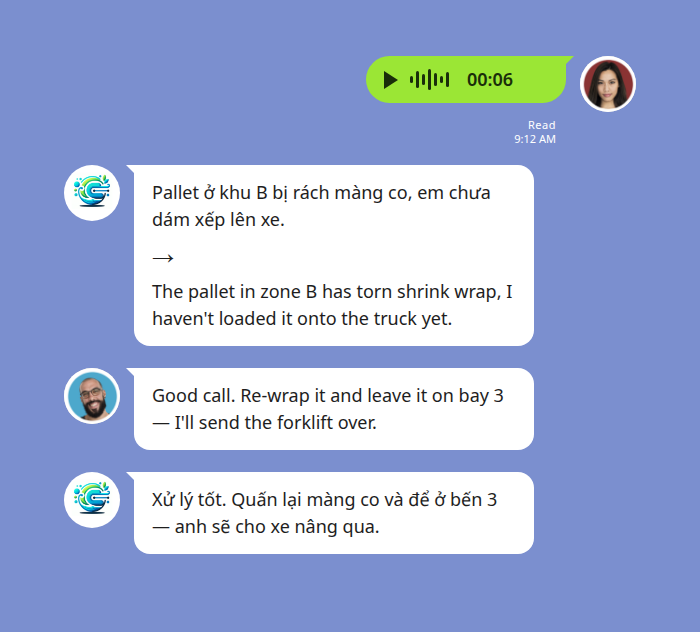
A floor voice note in Vietnamese, read by the supervisor in English — and the reply read back in Vietnamese.
The operator’s original voice note stays in the thread, so nothing is lost if someone wants to re-listen. The supervisor’s reply goes back as text and the operator reads it in Vietnamese — no app-switching, no copy-paste, no waiting for a bilingual coworker to be free. Background noise on a busy floor can degrade voice transcription, so for anything safety-critical the written confirmation in the thread is what the crew relies on.
Coordinating shipping and dispatch across a mixed crew
The strongest case for in-chat translation is the broadcast instruction — one message that has to reach a whole crew at the same moment, accurately. A single LINE group can carry up to five languages at once, and one source message is translated into every other language in the group simultaneously.
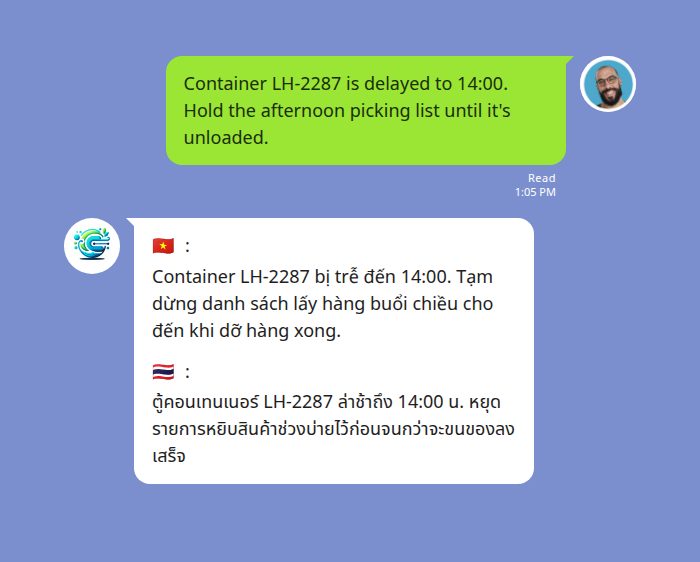
One dispatch instruction, written once in English, read by the Vietnamese and Thai crew at the same moment.
The dispatch lead writes once in English; the Vietnamese and Thai pickers read it in their own language in the same thread, at the same time. There’s no version of the instruction that only some of the crew received. And because the translated thread persists, the morning review has a record: who was told what, and when. When a hold instruction or a load-sequence change is questioned later, the thread is the audit artifact — not someone’s memory of a hallway conversation.
Warehouse translation tools compared
| Copy-paste app (e.g. Google Translate) | LINE in-app translate | Echonora | |
|---|---|---|---|
| Lives inside the team chat | No — switch apps, copy, paste back | Partial — per language pair | Yes — translation posts in the group |
| Mixed-language crew (3+ first languages) | One pair at a time | Limited per pair | 2–5 languages in one group |
| Voice notes from the floor | No | Text only | Voice and text both translated |
| Shared, reviewable record | None — copy-paste loses it | Personal / local only | Persistent translated thread |
| Setup for the worker | New app to learn | Built into LINE | Already in the LINE they use |
Copy-paste tools are fine for a one-off lookup, but they leave no shared record and break the moment a third reader is involved. The warehouse difference is the shared translated thread — every reader sees the same instruction, and it’s still there at handover.
Setting it up for a logistics team
Setup is a single message in the LINE group your crew already uses. There’s no separate app for workers to install and no new account to onboard:
- Add the Echonora bot to the group.
- Activate the languages with one message, for example
@Echonora english and vietnamese and thai. - Send a test message — the bot translates it into the other languages right in the thread.
Use plain language names rather than codes. Echonora supports 180+ languages, so the same pattern works whether your crew runs English with Vietnamese and Thai, or adds Indonesian and Tagalog. For the full list and exact activation syntax for any combination, see the supported languages and command reference.
You can validate it on one shift’s group for free — 20 messages a day, no credit card, no expiry — then move to an unlimited plan when a whole site is running on it. A paid plan is per user but covers every group that user is in, so you arrange accounts around shift leads and site supervisors, not one per picker. See data-handling specifics in the privacy policy.
Start Using Echonora — Break Language Barriers
180+ languages, real-time text and voice translation right inside your team’s LINE group.
Frequently asked questions
Does it work for voice notes from the warehouse floor?
Yes. LINE voice messages are transcribed and translated the same way text is, with the original voice note kept in the thread. Heavy background noise can reduce transcription accuracy, so treat the written translation in the thread as the reference for safety-critical instructions.
How many languages can one warehouse group handle?
Up to five first languages in a single LINE group. One source message is translated into all the other configured languages at once, so a broadcast dispatch instruction reaches the whole mixed crew simultaneously.
Do all our workers need a paid subscription?
No. A subscription is per user but extends the unlimited benefit to every group that user belongs to. Most logistics teams put paid accounts on shift leads and supervisors, who are members of the operational groups, rather than buying one per worker.
Keep your shipping floor moving in every language
Add Echonora to your warehouse LINE group and translate dispatch, inventory, and voice notes instantly.