

Restaurant & Kitchen Translation: Running a Multilingual F&B Team on LINE
Published
It’s 7:18 on a Friday. The floor is full, three tickets are hanging, and a server needs the kitchen to change a dish for table 12. The expediter speaks English. The wok station speaks Thai. The prep cook who actually has the chilli paste speaks Vietnamese. The instruction is simple — extra spicy, no fish sauce — but it has to cross two languages and a noisy pass before the dish goes out, and a fish-sauce mistake on an allergy table is not a small thing.
Most F&B operators have lived some version of this. The kitchen runs on a mix of first languages, the floor runs on another, and the gap between them is bridged by pointing, half-remembered phrases, and the one bilingual staff member everyone interrupts. It works until it’s busy — and it’s always busy when it matters.
This guide is about closing that gap inside the chat your team already uses. It’s a companion to the broader LINE translation for workplace teams guide, focused specifically on restaurants, cafés, and F&B kitchens.
The hidden cost of a language gap on the line
A language gap in a restaurant rarely shows up as one big failure. It shows up as a tax on everything, paid in three currencies:
- Remakes and waste. A misheard modifier — no peanuts, no pork, sauce on the side — becomes a remade plate. The cost isn’t just the food; it’s the ticket time, the table waiting, and the station falling behind for the rest of the rush.
- Safety and allergens. Allergen instructions are the highest-stakes messages in the building, and they’re often the ones shouted across the most noise. “Severe shellfish allergy” cannot be the message that gets lost in translation.
- Onboarding and turnover. A new cook who can’t follow the prep list or the shift brief takes longer to become useful and is more likely to leave. The language barrier quietly raises your training cost and your churn.
None of these are dramatic on any single night. Added up across a year of services, they’re the difference between a kitchen that runs and one that’s always one mistake behind.
How real-time translation works inside your kitchen’s LINE group
Most restaurant teams already coordinate on a LINE group — the floor, the kitchen, the closing crew. Echonora adds translation into that same group instead of asking anyone to switch to a separate app.
Add the bot to your existing staff group, tell it which languages your team speaks, and from then on every message posts in everyone’s language. A server types in English; the Thai line cook reads Thai; the Vietnamese prep cook reads Vietnamese — all in the one thread, visible to everyone. There’s nothing to copy, paste, or screenshot.
Two things make it fit a kitchen specifically:
- Voice messages translate the same way text does. A cook with gloves on, or a server moving between tables, can send a voice note instead of typing — the message is transcribed and the translation is posted in text, usually within a few seconds. Hands stay free; the message still lands.
- One group can carry up to five languages at once. A kitchen with English, Thai, and Vietnamese on the same shift doesn’t need three separate chats. One source message is translated into every other language in the group, and it still counts as a single translation event.
Because the translated message lives in the thread, it’s also a record. When the morning-after question is “who was told about the allergy table, and when,” the answer is in the chat — not in someone’s memory.
Three places F&B teams feel it most
Floor-to-kitchen order corrections
The most frequent cross-language message in any restaurant is a change to an order. The server knows what the guest wants; the kitchen has to execute it precisely. When the modifier crosses languages cleanly, the dish goes out right the first time.
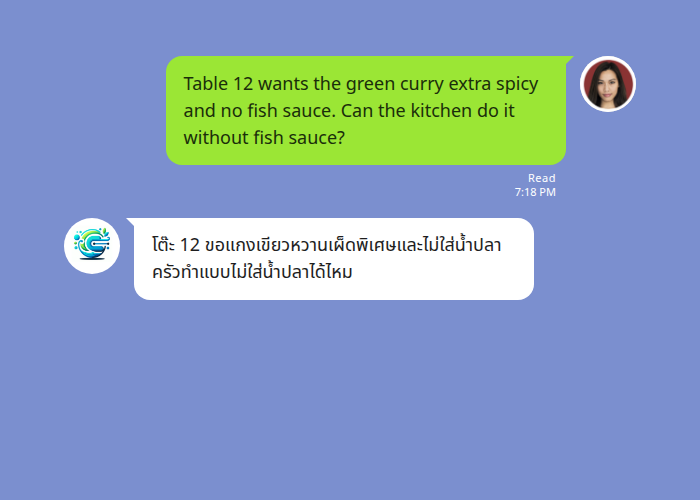
The server types the correction in English; the wok station reads it in Thai in the same group. No relaying through whoever happens to be bilingual, and the instruction is sitting in the thread if anyone needs to check it mid-service.
Allergen and dietary alerts when hands are full
Allergen messages are urgent and high-stakes, and they almost never arrive at a convenient moment. A voice note means the server doesn’t have to stop and type — they can say it once and keep moving.
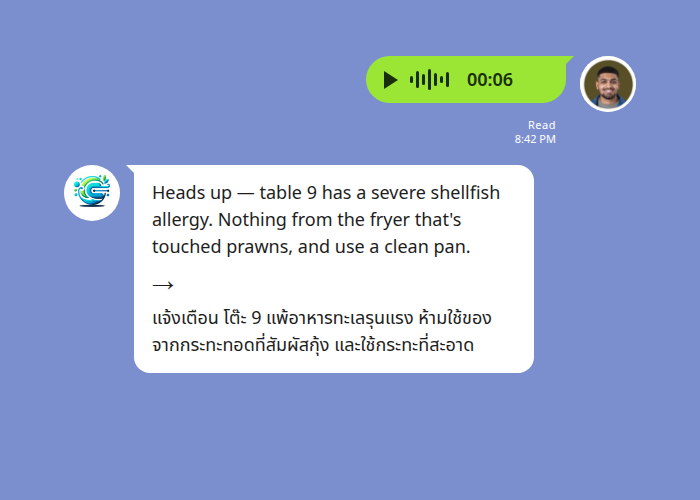
The server voice-notes the allergy alert; Echonora posts the transcript and the translation together, so the kitchen reads “severe shellfish allergy — clean pan, nothing from the fryer that’s touched prawns” in their own language. The original voice note stays in the thread, so nothing is lost. For sensitive operational topics like this, see Echonora’s privacy policy for how messages are handled.
Shift handover and prep lists across a mixed kitchen
Prep lists and shift briefs are where a new or multilingual cook either gets up to speed or quietly falls behind. A handover the whole kitchen can actually read is a handover that gets done.
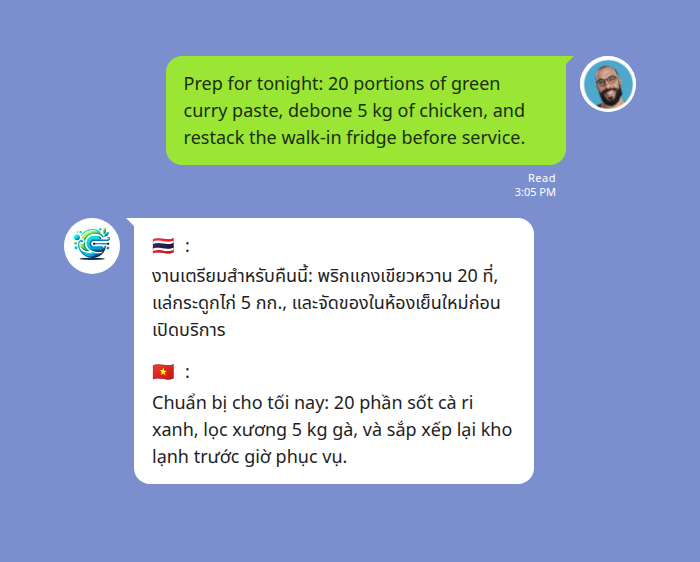
The head chef posts the prep list once in English; the Thai and Vietnamese cooks each read it in their own language, flagged so it’s clear which line is theirs. One message, one source of truth, every station on the same page before service.
Echonora vs Google Translate vs LINE in-app translate
| Google Translate | LINE in-app translate | Echonora | |
|---|---|---|---|
| Where it lives | Separate app — copy, switch, paste, switch back | Built into LINE, but per-language-pair | In your existing LINE staff group |
| Group visibility | None — each person translates privately | Personal/local — each user sees their own | Shared in the thread — the whole team sees the same translation |
| Languages at once | One pair at a time | Limited per-pair | 2–5 languages in one group |
| Voice messages | Manual, separate | Text only | Voice notes transcribed and translated inline |
| Leaves a record | No — copy-paste loses it | No persistent shared record | Yes — the translated thread is the audit trail |
For a kitchen mid-rush, the difference that matters is the first row: nobody is switching apps with their hands full. The translation is just there, in the chat everyone is already watching.
Start Using Echonora — Break Language Barriers
180+ languages, real-time text and voice translation right inside your team’s LINE group
Setting it up for your restaurant
You can have this running before your next service:
- Add Echonora to LINE and invite the bot into your existing staff group (floor + kitchen, or one group per shift).
- Set your languages. Send one message naming them — for example,
@Echonora English, Thai, and Vietnamese. You only need the language names; no codes to memorise. - Carry on as normal. Everyone keeps writing (or voice-noting) in their own language. The bot handles the rest.
Echonora supports 180+ languages, so whatever mix your team speaks — Thai, Vietnamese, Indonesian, Tagalog, Burmese, Mandarin, Nepali — the same setup works. See the full list of supported languages and exact activation syntax for every pair.
The free plan covers 20 messages a day with no credit card and no expiry — enough to validate it on a few real shifts before you decide. When a busy kitchen needs unlimited translation across every group, a single paid account covers every group that account is a member of, so you scale it by shift or by site rather than by headcount. Pricing is on echonora.com.
Frequently asked questions
Does the whole kitchen need to install or learn anything? No. If your team already uses a LINE group, they keep using it exactly as before. Only one person needs to add the bot and set the languages.
Can it handle voice notes from a noisy kitchen? Yes — voice messages are transcribed and translated like text. Very loud environments or heavy background noise can reduce transcription accuracy, so for the most safety-critical instructions a short typed message is the most reliable.
We have English, Thai, and Vietnamese on the same shift. Is that a problem? No. A single group can run 2 to 5 languages at once. One message is translated into every other language in the group automatically.
Do we need a paid account for every cook? No. A subscription is per user, but the benefit covers every group that user is in. Arrange paid accounts by shift lead or site, not per employee.
Is the chat history kept? Translations post into your LINE thread and stay there like any other message, which gives you a record of what was communicated. See the privacy policy for data-handling specifics.
Run your kitchen in every language your team speaks
Add Echonora to your staff LINE group and translate orders, allergens, and shift prep in real time — free to start, no credit card.