

The Multilingual Onboarding Checklist for Foreign Workers: A First-Week Communication Plan
Published
The first week sets the tone for everything that follows. For a foreign worker arriving in a new country, a new factory, and a new language all at once, those first five days are the highest-friction moment of the entire employment relationship — and the moment most likely to end in early turnover, a safety incident, or a misunderstanding that festers for months.
The fix is rarely a better contract or a bigger sign-on bonus. It’s a structured first-week communication plan: a checklist that makes sure the right information reaches a new hire in a language they actually read, on the day they need it. This guide gives you that checklist — pre-arrival, day one, and across the first week — built for HR teams and shift supervisors managing a multilingual workforce.
Why the first week decides whether a foreign worker stays
Most early attrition among foreign workers isn’t about pay. It’s about confusion — not knowing where to go, what’s expected, who to ask, or what a safety rule actually means. When every one of those answers arrives in a language the worker is still learning, small uncertainties compound into a decision to leave.
A communication plan attacks the root cause directly. When a new hire can read shift times, safety rules, and “ask me if you’re unsure” in their own language from day one, the workplace stops feeling like a test they’re failing and starts feeling like a team they’ve joined. That shift — from anxious to oriented — is what the first-week checklist below is designed to produce.
Before day one — the pre-arrival checklist
Onboarding starts before the worker walks through the gate. Send these in the worker’s first language at least a few days ahead, so they arrive prepared rather than overwhelmed:
- Start date, time, and exact meeting point — “Monday 8am, main gate” is clearer than an address. Include a photo of the entrance if you can.
- What to bring — ID, bank details, residence/work documents, and anything specific to your site.
- What to wear — and whether safety equipment is provided or needs to be collected on arrival.
- Who to contact — the name and a direct line to the one person they should message if anything goes wrong on the first morning.
- A simple “reply to confirm you got this” — confirmation closes the loop and surfaces problems while there’s still time to fix them.
The single most useful pre-arrival step is giving every new hire a way to ask questions in their own language before they arrive. A worker who can write “what documents do I need to bring?” and get a clear answer the night before starts day one calm instead of guessing.
Day one — first-contact communication essentials
Day one is mostly about reducing anxiety and removing ambiguity. Keep instructions short, concrete, and confirmable. The goal is not to explain the entire job — it’s to make sure the worker knows where to be, what’s safe, and who to ask.
A warm, readable first message does a lot of quiet work. Below, an HR coordinator welcomes a new Vietnamese hire in a shared LINE group — she types in English, and the new starter reads it in Vietnamese and replies in his own language, with the translation appearing inline for the whole team:
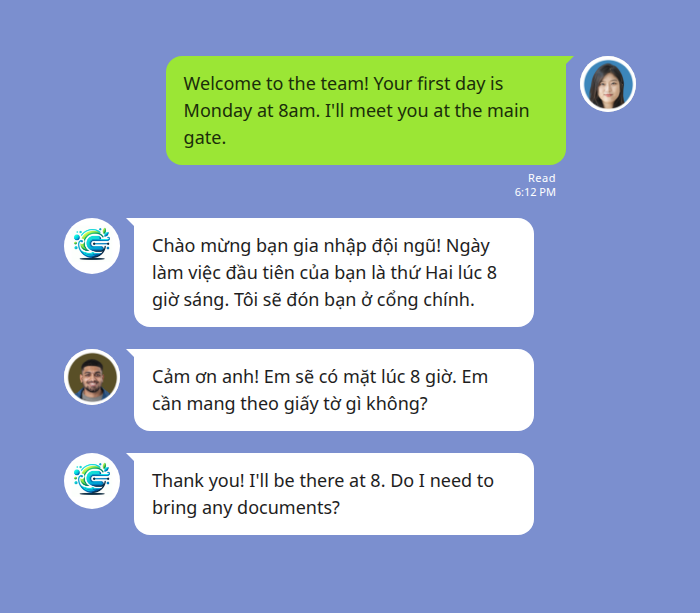
Notice what didn’t happen: no app-switching, no copy-paste into a separate translator, no private side-channel the supervisor can’t see. The exchange — and its translation — lives in the same group thread the whole crew uses, so there’s a shared, reviewable record from the very first message.
The first-week onboarding checklist (day by day)
Use this as a working SOP. Adapt the specifics to your site, but keep the principle: every item is delivered in the worker’s first language and confirmed, not assumed.
| Day | Communication focus | Checklist items |
|---|---|---|
| Day 1 | Arrival & safety basics | Welcome & introductions; site tour; emergency exits and assembly point; mandatory PPE issued; “who to ask” contact confirmed |
| Day 2 | Role & daily routine | Shift times and breaks; clock-in/out procedure; primary tasks demonstrated; supervisor expectations explained and confirmed |
| Day 3 | Standards & quality | Quality checks; what “done right” looks like; common mistakes and how to flag a problem early |
| Day 4 | People & culture | Team norms; pay date and payslip explained; leave/absence process; how to raise a concern |
| Day 5 | Check-in & feedback | One-to-one check-in; “what’s still unclear?”; confirm the worker knows where to find answers next week |
The day-5 check-in matters most. Ask, in the worker’s own language, “what’s still unclear?” — and make it genuinely easy to answer. The honest answers you get in week one are far cheaper to act on than the resignation you’d otherwise get in month two.
Safety and compliance can’t wait for fluency
Safety is the one area where “they’ll pick it up eventually” is not acceptable. PPE rules, exclusion zones, lockout procedures, and emergency steps all have to land on day one — in a language the worker fully understands — regardless of how much of the local language they’ve learned.
In a group with several nationalities, a single reminder should reach everyone at once, each person reading it in their own language. Here a supervisor posts one safety reminder in English, and new starters read it in Vietnamese and Indonesian simultaneously:
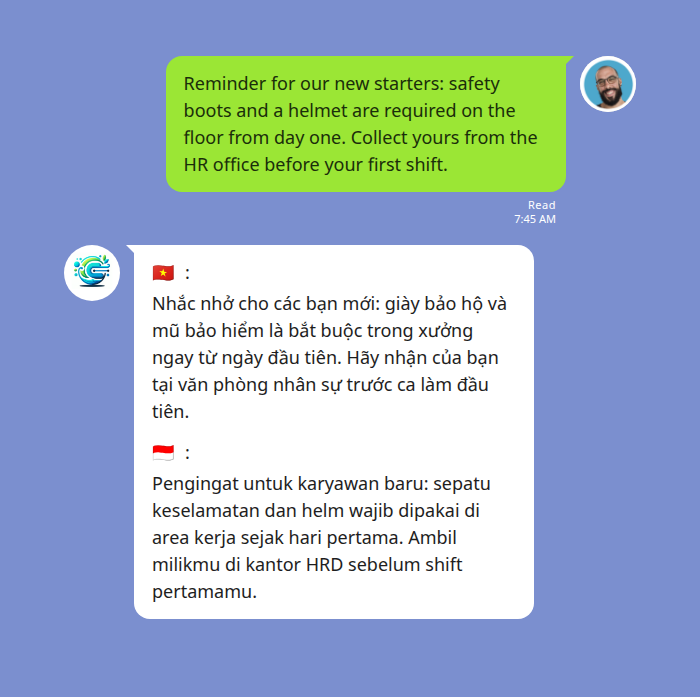
Because the message and its translations stay in the thread, you also get something compliance teams care about: a timestamped record that the safety instruction was delivered, in each worker’s language, before the shift started. For sensitive workplace communication, see the privacy policy for data-handling specifics.
Where a LINE translation bot fits into onboarding
Most foreign workers in LINE-heavy regions already use the app every day with family and their diaspora community. That makes it the lowest-friction place to run onboarding — there’s no new account to create, no separate app to teach, and no software to install during an already overwhelming first week. Echonora is a translation bot that lives inside the LINE group your team already uses.
You invite the bot into an onboarding group and activate the languages you need with a plain-language command — for example @Echonora english and vietnamese, or for a mixed crew @Echonora english and vietnamese and indonesian. From then on, every message is translated inline for the whole group. A few things that make it a natural fit for onboarding:
- 180+ languages, with 2 to 5 languages supported simultaneously in a single group — enough for a mixed-nationality intake.
- Voice messages translate too. A supervisor wearing gloves can send a quick voice note; the bot transcribes it and posts the translation as text the whole crew can read — typically within a few seconds.
- A shared, reviewable thread. Unlike per-device private translation, everyone sees the same translated message, so an HR lead or bilingual colleague can audit what was actually communicated.
- No cost to start. The free plan covers 20 messages a day — no credit card, no expiry — which is plenty to validate it on one onboarding group before rolling it out. Subscriptions are per user, and the unlimited benefit extends to every group that user is in, so one team lead can cover several onboarding groups.
This page is part of our broader guide to LINE translation for workplace teams — start there for the full picture on running multilingual teams day to day. For the exact activation syntax and the complete language list, see the full list of supported languages and setup.
Start Using Echonora — Break Language Barriers
180+ languages, real-time text and voice translation right inside your LINE group
Frequently asked questions
How much of onboarding should be translated?
Prioritise anything tied to safety, pay, attendance, and “who to ask.” Those are the items where a misunderstanding is expensive or dangerous. Everything else benefits from translation too, but start there if you’re building the plan incrementally.
What if our new hires speak several different languages?
A single group can run 2 to 5 languages at once, with each person reading every message in their own. One reminder from a supervisor reaches a Vietnamese, Indonesian, and Thai worker simultaneously — no separate message per language.
Do workers need to learn anything new?
No. They use LINE exactly as they already do — type or send a voice note in their own language. The translation appears in the group automatically, so there’s nothing extra to install or learn during the first week.
Can we keep a record of what was communicated?
Yes. Because translations post into the group thread, you get a timestamped, reviewable record — useful for confirming a safety briefing was delivered in each worker’s language before a shift.
Give every new hire a clear first week
Run your onboarding group in 180+ languages — free to start, no credit card, no expiry