

How Couples Use LINE Translation for Long-Distance Relationships Across Time Zones
Published
It’s 11:42 PM in Tokyo. Haruka is brushing her teeth, scrolling through the day’s messages one last time. It’s 10:43 AM in New York. Daniel is on his second coffee, between meetings, watching her good-night land on his screen as he begins his morning.
They’ve been together two years. They’ve never lived in the same time zone for more than three weeks at a stretch. And until last spring, every message between them passed through a translation app one of them had to open, copy into, wait on, and paste back. The lag was small — maybe forty seconds per exchange. But forty seconds when you’re already tired, or already running late, adds up to a relationship that slowly forgets what it feels like to just speak.
This post is for couples in that shape. People who fell in love across a language line, then ended up across a time-zone line too. The everyday question isn’t whether you can translate — it’s whether translation can stop being a chore and start being invisible, the way a shared language is invisible.
The hidden cost of writing love in a second language
A lot of long-distance couples are also cross-language couples. One partner’s first language might be Japanese, Korean, Tagalog, Vietnamese, Spanish, Mandarin. The other’s might be English, German, French. You meet at a conference, on a study-abroad year, in a game lobby, through mutual friends at a wedding. You start dating in whichever language you can both manage. Usually that’s a second language for one of you.
For a while, the second-language part is romantic. You’re learning each other in slow motion. The funny mistakes are part of the relationship.
Then the relationship gets longer. You start needing to say things that have weight — I’m scared, I miss you, I don’t know what to do, please don’t be angry, I just had a hard day. And the second-language version of those sentences isn’t quite right. It’s flatter than what you’d say in your own language. It’s shaped by whatever vocabulary you happen to have, not by what you actually feel.
The person reading it doesn’t know what got lost. They just feel the affection landing a little off. Every night. For months.
That’s the hidden cost. Not whether the words are translated — they are, by both of you, every day. The cost is the energy it takes to write them, and the small accuracy gap that builds up over a year.
LINE translation in your shared chat is one way to put that energy back. You write in your first language. They read in theirs. They reply in theirs. You read in yours. The bot sits inside the conversation, posts the translation right under each message, and nobody opens another app.
How LINE translation fits into a long-distance couple’s day
Most cross-border couples we hear from already use LINE. It’s the default chat app across Japan, Taiwan, and Thailand, and it’s the chat their partner’s family is on — so the couple ends up there too. If you’re on a different chat app and curious how the same idea works across families, parenting, and caregiving, our parent guide on translation for cross-cultural families maps out the wider use cases.
The setup is simple. You add @Echonora to your couple chat — just the two of you, no group needed beyond the LINE 1:1 — and type one line to tell it which two languages you’re using. After that, it stays in the chat and translates everything in both directions until you tell it to stop.
The bot doesn’t replace your messages. Your original text stays exactly where you typed it, in your own language. Underneath, the translation appears in your partner’s language. So your partner sees both: what you wrote, and what it means. And vice versa. Nothing is overwritten, nothing is privatised, nothing requires either of you to copy-paste.
For couples across time zones, the practical part is this: the translation arrives in seconds, not minutes. The partner who’s awake can read in their first language without having to be alert enough to translate. The partner who’s about to sleep can write in their first language without having to be alert enough to translate.
That sounds small. It isn’t. The energy budget at 11 PM in Tokyo and the energy budget at 11 AM in New York are not the same energy budget. The one ending their day is running low; the one starting theirs is running high. Putting translation between you means the tired one doesn’t have to spend the last of their evening building English sentences. They can write in Japanese and go to bed.
Three scenes from couples across time zones
1. Goodnight, when one of you is starting their day
Haruka in Tokyo, Daniel in New York. Fourteen-hour gap. Her last message of the day is his first one of the morning, and his last is her morning.
In Japanese she can say what she means without searching for the English shape of it: おやすみ、今日も一日お疲れさま. The bot puts the English right under it. Daniel reads “Goodnight. Thank you for today.” — which is what she actually meant, not the shorter, blunter version she would have managed in her second language at midnight.
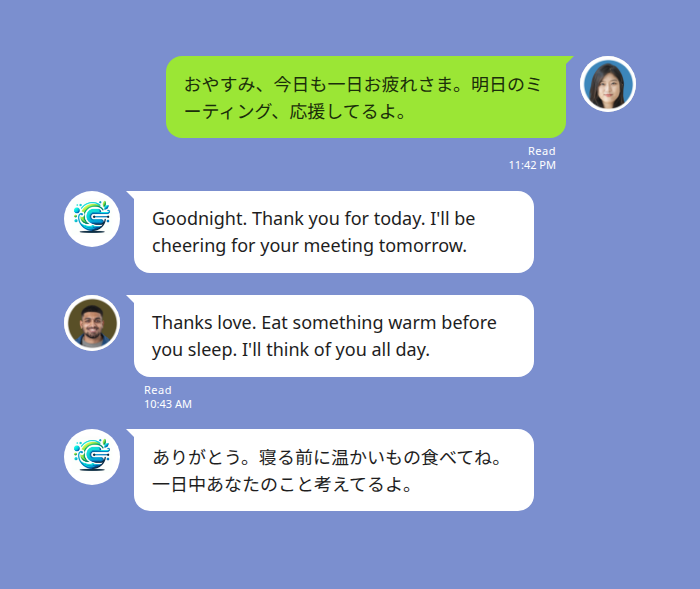
A goodnight exchange between Tokyo and New York. Both partners write in their first language; Echonora posts the translation inline.
He replies in English with a small instruction — eat something warm before you sleep — and a longer thought he wouldn’t have bothered translating if he had to do it manually. She reads it in Japanese before her phone goes face-down on the nightstand.
The whole exchange takes ninety seconds. Both of them said the actual thing they wanted to say.
2. Morning coffee, evening leftovers
Rosa in Manila, Marcus in Toronto. Twelve-hour gap that flips with daylight saving. She’s just finished dinner; he’s just woken up.
These are the messages that get cut first in a tired long-distance relationship — the did you eat, I cooked your favourite, I wish you were here kind. They’re small. They’re hard to be bothered to translate. They’re also the load-bearing tissue of an actual day-to-day relationship.
In Tagalog: Kumain ka na ba? Nagluto ako ng adobo, sana nandito ka. The bot translates it inline. He reads it in English the second he picks up his phone, replies in English asking about her day, and his question reaches her in Tagalog while she’s washing up.
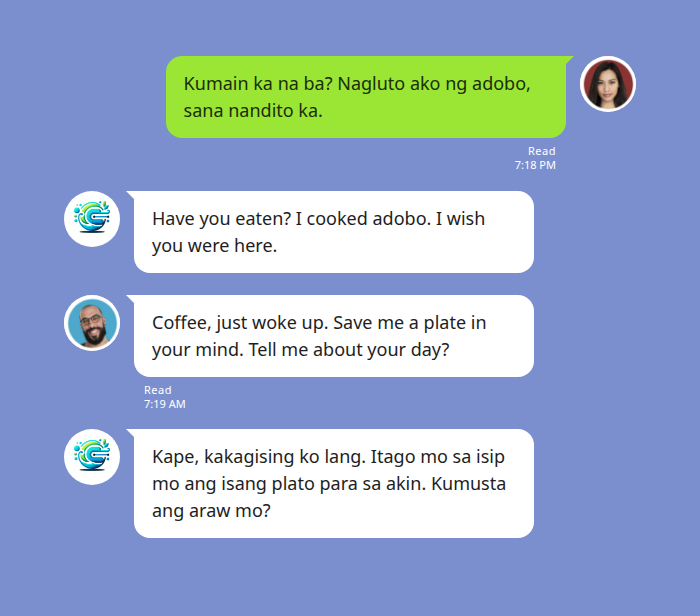
The small daily messages — “did you eat?”, “I cooked your favourite” — across a twelve-hour gap, in both languages at once.
The point isn’t that any one message is irreplaceable. The point is that the flow of small messages — the texture of a couple actually living parallel days — survives. Without inline translation, those messages get traded for the high-effort important ones, and a relationship that only exchanges important messages stops feeling like a relationship.
3. The hard-day message you only want to write in your first language
Minji in Seoul, Elliot in San Francisco. Sixteen-hour gap. She’s getting into bed; he’s just woken up to her message.
She’d had a presentation that morning. It hadn’t gone the way she practiced. The kind of day where you don’t have any English left in you — you barely have your own language left in you — and the last thing you want to do is shape a feeling into a second-language sentence so your partner can understand it.
In Korean: 오늘 진짜 힘들었어. 회의에서 발표할 때 머리가 하얘져서… 너랑 한국어로 이야기하고 싶어.
She didn’t have to construct that in English. The bot did. Elliot read “Today was really hard. My mind went blank during the presentation… I just want to talk to you in Korean.” and replied in English: tell me everything, in your words. I’ll read it slowly. You don’t have to translate yourself tonight.
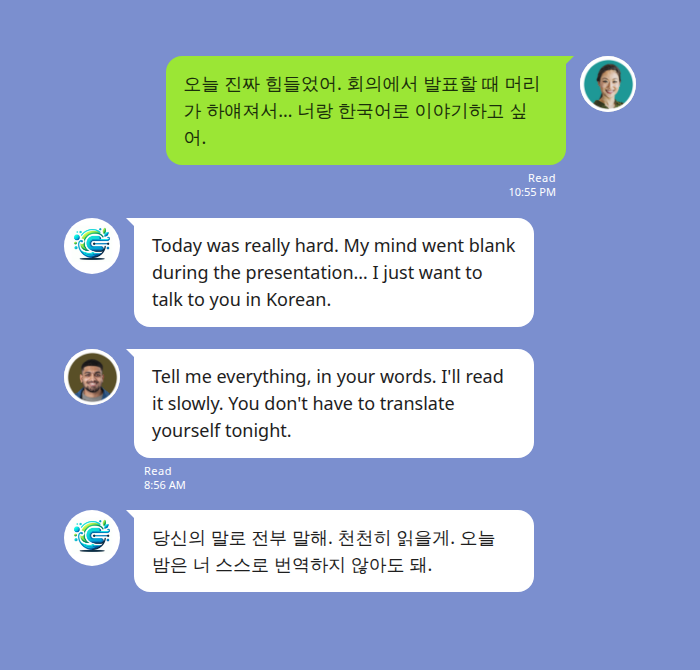
When the day is too heavy to translate yourself, writing in your first language and being read in your partner’s lets you show up as yourself.
The translation isn’t doing the relational work. He is. But the translation lets her show up at the end of a hard day as herself, in her own language, instead of as a tired second-language version of herself. And it lets him meet her there.
Setting it up — what to type, in 60 seconds
You add @Echonora to LINE (it’s free to add, no credit card, no expiry on the free tier), and in your couple chat you type:
@Echonora english and japaneseOr whichever two languages you actually use. The bot recognises 180+ languages, so almost any pair you’re likely to be in will work — English with Japanese, Korean, Tagalog, Vietnamese, Mandarin, Thai, Spanish, German, French, and so on.
After that, every message either of you sends gets translated underneath. You don’t have to invoke the bot again. It stays in the chat. If you want to add a third language later — say, when your partner’s mother joins the chat for a holiday — you can.
Voice messages translate too. If you’d rather record a goodnight than type one, the bot transcribes the voice note and posts the translation in text underneath. Your original voice file stays in the chat as well, so your partner still gets to hear your voice; they just also get the words.
When it helps most — and what it can’t do
LINE translation is good at the texture of a relationship: the daily check-ins, the small affections, the funny dumb messages, the hard-day messages, the planning messages, the I saw this and thought of you messages. The volume goes up; the second-language friction goes down.
It’s also good at the moments when one of you is tired and the other isn’t. The tired person gets to write in their first language. The fresh person gets to read in theirs.
What it doesn’t do — and shouldn’t pretend to — is replace presence. The hard part of long-distance isn’t the words. It’s the absence. Translation can’t close that. It can only keep the words honest while the absence does its work, until you’re together again. That’s still worth a lot. It’s just not everything.
It also won’t be perfect on poetry, in-jokes, or the very specific things only one of you would say. The bot handles register and idiom well enough that most days you forget it’s there, but if you write a pun, expect the pun to land in literal translation. That’s part of why we don’t recommend ripping the original text out of view: you both get to see what was actually said, in the actual words.
For privacy specifics — what stays in your LINE thread, what doesn’t — see the Echonora privacy policy.
Start Using Echonora — Break Language Barriers
180+ languages, in-thread translation for couples and families on LINE
Frequently asked
Does this work for any two languages? Almost. Echonora supports 186 languages from the ISO 639-1 list — see the full list of supported languages and exact activation syntax. For the common cross-border-couple pairs (English with Japanese, Korean, Mandarin, Tagalog, Vietnamese, Thai, Indonesian, Spanish, French, German), it’s well-tested.
What does it cost? The free plan gives you 20 messages a day, no credit card, no expiry. That’s enough for a quiet day of small check-ins. For couples in regular contact — especially around time-zone hand-offs, hard days, and trip planning — most upgrade to the unlimited plan. Pricing lives on echonora.com.
Will my partner see my original message, or only the translation? Both. Your original text in your own language stays in the chat exactly as you typed it. The bot adds the translation underneath. Nothing is overwritten. Either of you can scroll up and see both versions.
Does it work with voice messages? Yes. The bot transcribes and translates LINE voice notes within a few seconds. Your partner sees the transcription in their language; your original voice file stays in the chat so they can still hear you.
What if we sometimes want to write in each other’s language anyway, as practice? Go ahead. The bot translates whatever appears in the chat. If you type in your partner’s language, it’ll appear translated back to your language underneath, which is sometimes a useful check on whether you said what you meant.
How do I cancel if it doesn’t fit? echonora.com/subscription — self-service, any time, no email or call required.
Where to go next
If you’re in a cross-border relationship with kids, partners’ parents, or a wider family chat across languages, the broader picture is in our parent guide: Cross-Cultural Family LINE Translator Guide.
If you’re ready to try it tonight — the next time-zone hand-off is probably already on the calendar — you can add the bot in one tap and have it running in your chat before the next goodnight.
Start Using Echonora — Break Language Barriers
180+ languages, in-thread translation for couples and families on LINE