

LINE Translation Bot Privacy and Security: How Your Chat Data Stays Protected
Published
Before a translation bot reads a single message in your group, someone on your team should be able to answer one question: where does that message go, and who can see it afterwards? For a family group the stakes are personal. For a company group — supplier negotiations, shift coordination, HR conversations with migrant staff — the stakes are commercial and sometimes regulatory. Privacy is not a footnote to the decision to add an in-chat translator; for most buyers it is the decision.
This post walks through how chat data is handled when you add a LINE translation bot to a group, what is processed and what is not, who can see the conversation, and the specific questions worth asking any vendor before you let software into a chat your team relies on. It is a companion to our broader guide to using a LINE translation bot, focused on the trust and data-handling layer rather than setup.
Why Privacy Is the First Question for In-Chat Translation
An in-chat translator is different from a standalone translation app in one way that matters for privacy: it reads messages automatically, as they arrive, without anyone pressing translate. That is exactly what makes it useful — a supervisor writes once and the whole crew reads in their own language — and it is also why the data question is not optional. A copy-paste workflow into a separate app exposes only the snippets you choose to paste. A bot in the group sees the group.
For a business buyer evaluating that trade-off, three concerns tend to surface:
- Exposure. Conversations often contain more than logistics — pay, performance, supplier pricing, personal circumstances. Who or what processes those messages, and is that processing limited to delivering the translation?
- Retention and use. Are messages kept, and if so, are they ever used for anything beyond the service the group signed up for — training, profiling, advertising, resale?
- Visibility. In a mixed-language group, can each person trust that everyone is reading the same thing, and that nothing is being quietly shown to one party and not another?
The rest of this post answers each of those in turn, then turns them into a checklist you can run against any translation bot — not only Echonora.
Where Your Messages Actually Go
When a message lands in a LINE group that has a translation bot, the data path is short and worth understanding plainly. The message is delivered by LINE to the bot, the bot processes the text to produce a translation, and the translation is posted straight back into the same LINE thread. The conversation continues to live where it always did — inside the LINE group, visible to the people invited to it.
Two technical facts shape the privacy picture:
- Translation is server-side, not on-device. Producing a high-quality translation across 180+ languages — including voice notes, which are transcribed and then translated — is done by language models running on servers, not locally on each phone. That is what makes the quality and language coverage possible; it also means the message text is processed off-device to generate the translation. This is true of essentially any high-accuracy translation service, and it is the honest trade for translation that actually reads naturally.
- The thread stays the home of the conversation. The bot adds translations to the LINE thread; it does not move your conversation into a separate app or a portal your team has to log into. What your group sees in LINE is the record.
The exact specifics of data handling — retention, processing locations, the legal terms — are governed by Echonora’s privacy policy, which is the source of truth. Data-handling rules also vary by country, and the privacy policy is where those specifics live rather than in a marketing page that can drift out of date. The point of this section is the shape of the flow: message in, translation processed, translation back in the same thread.
What the Bot Does — and Doesn’t Do — With Your Chats
The most important distinction in any data-handling conversation is between processing to deliver the service and using the data for something else. A translation bot has to read your message to translate it — that is the service. The question that separates a trustworthy tool from a costly one is whether anything happens to the message beyond that.
Echonora’s position is straightforward: chats are processed to deliver translation, and that is it. They are not sold as a marketing surface, and the group’s conversation is not the product being monetised — the subscription is. That distinction is worth stating in a contract-evaluation context because the alternative business model, where a “free” tool monetises the conversations it reads, is exactly the risk a procurement reviewer is paid to catch.
A few practical implications follow from that for a business group:
- The conversation is not a marketing asset. Your supplier pricing and your roster are not being mined to target ads or build a profile you did not agree to.
- The free plan is not the catch. Echonora’s free tier (20 messages a day, no credit card, no expiry) is a genuine evaluation tier, not a data-for-access trade. The paid plans — billed in USD, with one paying member covering the whole group — are how the service is funded.
- Specifics live in the policy, not in the pitch. Anything that needs to be precise and current — retention windows, how to request deletion, processing detail — belongs in the privacy policy, and you should read it before a company-wide rollout the same way you would read any vendor’s data terms.
Who Can See the Conversation
In a LINE group with a translation bot, the audience for the conversation is the group. The people invited to the LINE group see the messages and the translations; the bot posts back into that same thread rather than into any private side-channel. This is a deliberate design property, and for many business cases it is a feature rather than a risk.
It is worth contrasting with the other common model. Some translation features show each person a private, local translation on their own device — the supervisor reads their version, the worker reads theirs, and nothing shared persists in the thread. That is fine for a quick one-to-one exchange. But it means there is no single shared record: if a worker and a manager later disagree about what was communicated, there is nothing to point to.
The shared-thread model produces the opposite: one conversation, one set of translations, visible to everyone in the group and preserved in the chat history.
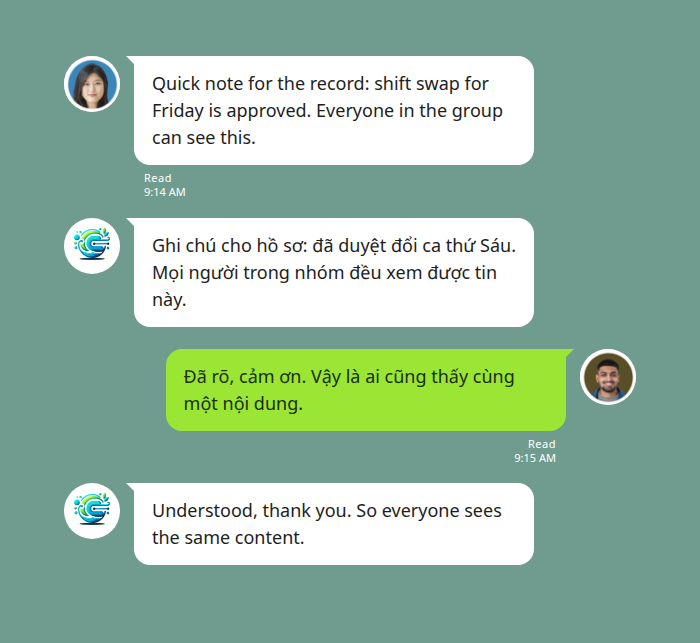
For a business that values reviewability, this matters in two directions:
- Transparency to the people in the group. Because the translation is posted in-thread, a bilingual member can sanity-check it on the spot. Nothing is being shown to one party and hidden from another.
- A reviewable record when it counts. If a dispute or a question arises later about what was said and in what language, the thread is the artefact — timestamped, in every language the group runs. A trusted bilingual colleague, family member, or advisor can be invited into the group to read the actual translated history rather than relying on anyone’s recollection.
The same property does carry a responsibility: because the conversation is shared and preserved, keep sensitive one-to-one matters in a one-to-one channel, and treat a company group the way you would any other written business record.
Security Questions to Ask Any Translation Bot Before You Add It
Whether or not you choose Echonora, the same short list will tell you most of what you need to know about a translation bot’s data posture. Run it against any vendor:
- What is processed, and only to deliver translation? The bot must read messages to translate them. Confirm that reading is scoped to producing the translation and nothing further.
- Is the conversation ever sold, used for advertising, or used to build a profile? A clear no — in writing, in the policy — is the answer you want. A “free” tool with no stated business model is the one to question.
- Where is the data handling documented? There should be a real privacy policy you can read, not a one-line reassurance. Specifics on retention and deletion belong there.
- Is the translation shared in the thread or private to each device? Decide which model you actually want. Shared-thread gives you a reviewable record; private-local gives you no shared artefact. Neither is wrong — but know which you are buying.
- Who controls the group, and who can add or remove the bot? In LINE, that is the group’s members and admins — not the vendor. The bot stays because the group keeps it.
- What is the funding model? If you can see how the company makes money (here: a USD subscription), you can reason about whether your conversation is the product. If you cannot, assume it might be.
A vendor that answers these plainly, and points you to a written policy for the precise terms, is behaving the way you want a tool handling your team’s chat to behave.
Setting Up a Privacy-Conscious Translation Group
Most of the privacy outcome is determined by how you run the group, not just which bot you add. A few habits keep a translated group clean:
- Scope the group to its purpose. A roster-and-logistics group does not need to carry pay-dispute or disciplinary conversations. Keep sensitive one-to-one matters in a one-to-one chat, where the audience is two people.
- Be deliberate about membership. The audience for the conversation is whoever is in the group. Review membership when people join or leave a team, the same way you would a shared drive or a distribution list.
- Activate only the languages you need. Configure the group with the two to five languages actually represented — one message in the group, for example
@Echonora English and Vietnamese— rather than over-provisioning. Fewer moving parts, clearer thread. - Treat the thread as a record. Because the shared history is reviewable, that is a benefit when you want an audit trail and a responsibility when you do not. Decide which groups are records and run them accordingly.
- Read the policy before a wide rollout. For a company-wide deployment, read the privacy policy the way you would any vendor’s data terms, and confirm it satisfies your own internal requirements. Echonora supports 180+ languages; the full list of supported languages and activation syntax is available if you need to confirm a specific pair.
Translation your team can trust, inside the chat you already use
Chats are processed to deliver translation — never sold. 180+ languages, in-thread, with a written privacy policy you can read before you roll out.
Frequently Asked Questions
Can Echonora read all the messages in my group?
To translate a message, the bot has to read it — that is how any in-chat translator works. The processing is scoped to producing the translation, which is then posted back into the same LINE thread. The conversation stays inside the group with the people you invited. For the precise terms on how message data is handled and retained, the privacy policy is the source of truth.
Are my chats sold or used for advertising?
No. Chats are processed to deliver translation and are not sold as a marketing surface. The service is funded by the subscription (USD $10/month or $100/year), not by monetising your conversations. That distinction is the one worth confirming with any “free” translation tool whose business model is not stated.
Is the translation done on my phone or on a server?
On a server. High-accuracy translation across 180+ languages, including transcription of voice notes, is done by language models running server-side rather than on each device. That is what enables the quality and language coverage; it also means message text is processed off-device to produce the translation, which is true of essentially any high-accuracy translation service.
Who can see the translations the bot posts?
Everyone in the LINE group, and only them. The bot posts translations into the same thread rather than to a private side-channel, so the conversation and its translations are visible to the group’s members. Nothing is shown to one party and hidden from another — which is part of why the thread works as a shared, reviewable record.
Can I delete the data, or remove the bot?
The group’s members and admins control the group in LINE — you can remove the bot from the group at any time, and the bot stays only because the group keeps it. For requests about message data specifically, follow the process described in the privacy policy, which documents how data handling and any deletion requests are managed.
Does Echonora meet a specific regulation or hold a particular certification?
Data-handling requirements vary by country, and the details that need to be precise and current live in the privacy policy rather than in a blog post that can drift out of date. For a company-wide or regulated deployment, read the policy and confirm it satisfies your own internal and legal requirements before rolling out. If you have a specific question, you can contact the team by adding the bot in LINE and sending a direct message.
Is the free plan a way to harvest data?
No. The free plan (20 messages a day, no credit card, no expiry) is a genuine evaluation tier, handled the same way as paid usage — chats processed to translate, not sold. The service is funded by subscriptions, so the free plan is a way to try the product, not a data-for-access trade. Current pricing is on echonora.com.
Try it on one group before you trust it with the company
Add Echonora to a single LINE group, read the privacy policy, and see exactly how the translations land — in-thread, shared, and yours. Free plan: 20 messages a day, no credit card, no expiry.