

Hotel Housekeeping Translation: Managing Multilingual Cleaning Teams on LINE
Published
It’s 7:15 on a 180-room property. The housekeeping supervisor is briefing the morning floor team before the carts roll: two room attendants from Indonesia, one from Vietnam, one from Thailand, and a houseman who reads English. The briefing covers a VIP late checkout on 4, a chemical-handling reminder, and three rooms flagged for deep clean. By the time the team scatters to their floors, the supervisor has no way to know who actually understood which part.
Housekeeping is the one department where a missed message shows up in a guest review the same day. A room held too long, a “do not disturb” ignored, a maintenance defect that sat for three hours because the attendant who spotted it couldn’t report it in a language the duty manager reads — each of those is a service-recovery cost that started as a translation gap on the floor.
The real cost of a missed message on the housekeeping floor
The expensive part of a housekeeping miscommunication is rarely the words. It’s the latency and the rework.
- Direct financial: a room that turns 90 minutes late blocks an early check-in; a guest amenity request that never reaches the attendant becomes a comped night.
- Schedule: the supervisor stops walking floors and starts walking translations — repeating the same instruction four times, in person, instead of running the board.
- Risk: chemical handling, slip hazards, and lost-and-found chain-of-custody are exactly the messages you most need every attendant to read correctly, and exactly the ones most likely to be skipped when the reader isn’t fluent.
Most properties already run housekeeping coordination through a LINE group — it’s where the morning board, the room reassignments, and the “who’s covering 6th floor” messages live. The gap isn’t the channel. It’s that the channel only works for whoever reads the language the supervisor types in.
Where the language gaps actually show up
Four moments account for most of the friction:
- Room status and reassignments — “hold 412 until 2 PM,” “skip 305, guest extended,” “609 is a checkout, prioritise it.” Time-sensitive, and wrong-language means wrong-room.
- Guest requests routed to the floor — extra towels, a late checkout, a hypoallergenic pillow. These come in from the front desk in the property’s working language and have to land with the attendant on that floor.
- Defect and maintenance reports — the attendant is the property’s first sensor for a leak, a broken lock, a failed AC. If they can only report it to a supervisor who shares their language, the report waits.
- Chemical and safety briefings — the messages with real liability attached. These cannot rely on “they probably understood.”
How Echonora works inside the team’s existing LINE group
Echonora is a translation bot that lives inside the LINE group your housekeeping team already uses. No new app for attendants to download, no account to create, no separate login at the start of a shift. The supervisor invites the bot into the group once and sets the languages with a plain-text command — for an English supervisor running an Indonesian-speaking floor, that’s @Echonora english and indonesian.
From then on, every message posts in both languages, in the same thread:
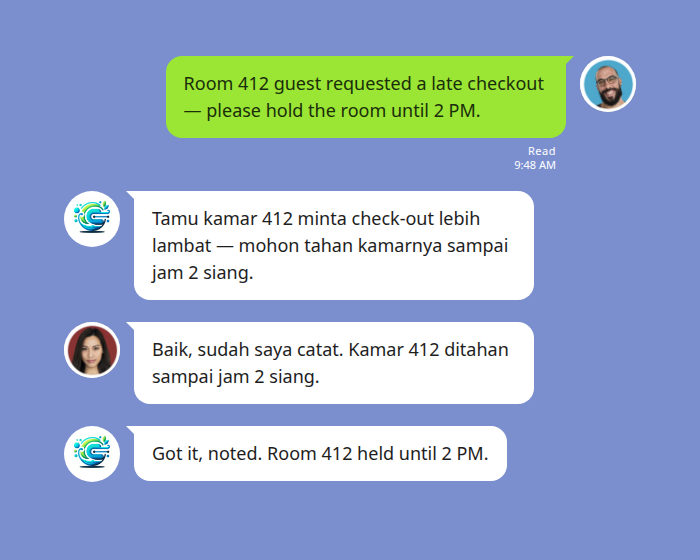
A room-status instruction typed once in English lands in Indonesian for the attendant — and her confirmation comes back in English, in the same thread.
The supervisor types the instruction once. The attendant reads it in her language and her reply is translated back. The whole exchange stays in the group, so the duty manager scrolling the thread at 2 PM can see exactly what was agreed about 412 — the thread is the record.
Voice notes for hands-busy attendants
Housekeeping is a gloves-on, cart-in-hand job. Typing a defect report mid-room is friction; a voice note isn’t. Echonora translates LINE voice messages the same way it handles text — the attendant records in her language, and the bot posts the transcription plus the translation in the thread.
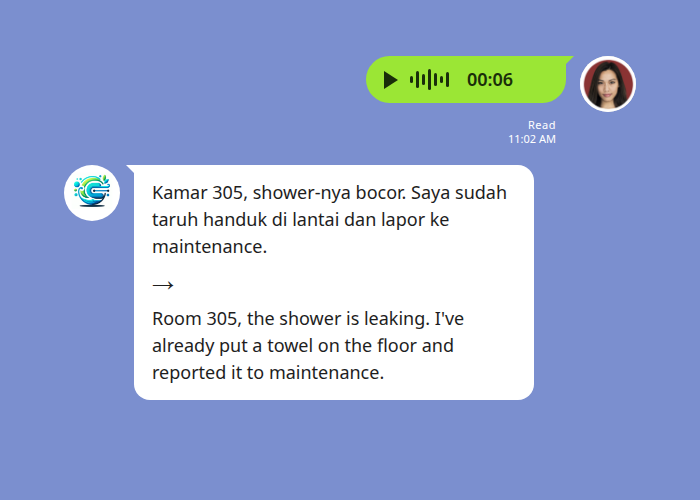
An attendant voice-notes a leaking shower in Indonesian; the supervisor reads it in English seconds later, with the original note preserved in the thread.
Translation typically arrives in a few seconds — conversational pace. The attendant keeps moving; the maintenance ticket gets raised from an English-readable report instead of a three-hour delay. (Heavy floor noise — vacuums, fans — can degrade voice recognition, so the clearest reports come from a quiet corner of the room.)
One group, every language on the floor
Most properties don’t run a single language pair. A real housekeeping team is Indonesian and Vietnamese and Thai, all in the same group. Echonora supports 2 to 5 languages in one LINE group — the supervisor posts once, and each attendant reads the same message in their own language.
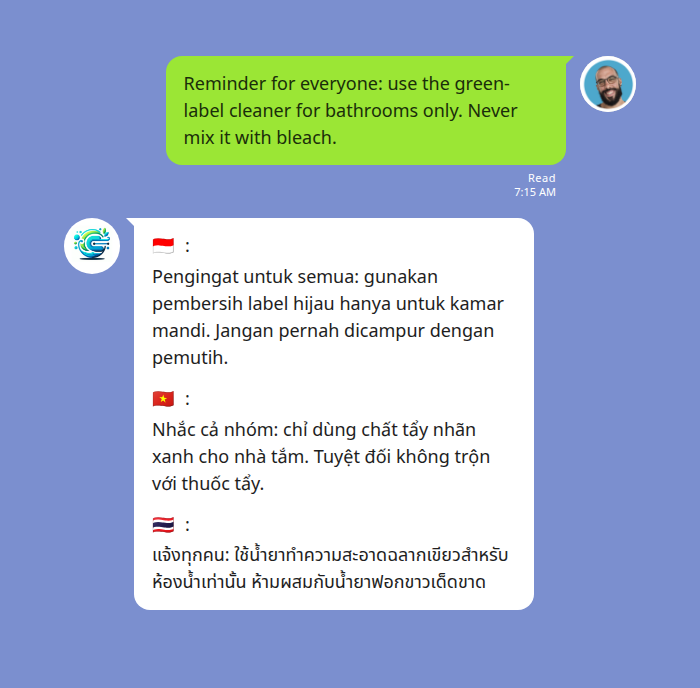
One chemical-safety reminder, posted once in English, lands in Indonesian, Vietnamese, and Thai — each attendant reading the same instruction in their own language.
This is the difference between a safety briefing you hope landed and one you can see landed. For the messages that carry liability — chemical handling, slip hazards, evacuation routes — a single source message rendered into every language on the floor is the cleanest way to make sure no one was left guessing. For the full list of supported languages and exact setup syntax, see the supported-languages reference.
Start Using Echonora — Break Language Barriers
180+ languages, instant text and voice translation right inside your team’s LINE group.
Getting started without retraining the floor
The reason translation tools fail in housekeeping isn’t accuracy — it’s adoption. Anything that asks an attendant to learn new software at the start of a shift gets abandoned by week two. The onramp here is the group chat the team already opens fifty times a day.
You can validate it on one floor’s LINE group before rolling it across the property — the free plan covers 20 messages a day, with no credit card and no expiry, which is enough to prove the workflow on a single shift. When daily volume across the team outgrows that, the unlimited plan covers every group a paid member is in. See current pricing on echonora.com.
This post is part of our guide to LINE Translation for Workplace Teams — see the pillar for the full picture across shifts, sites, and departments. Messages are processed to deliver translation and stay in your LINE thread; see the privacy policy for data-handling specifics.
FAQ
Do my housekeeping staff need to install anything? No. Echonora runs inside your existing LINE group. Attendants keep using LINE exactly as they do now — the bot adds the translations into the same thread. There’s no separate app and no account for them to set up.
Can it handle a team that speaks three or four different languages? Yes. A single LINE group supports 2 to 5 languages at once. The supervisor posts one message and each attendant reads it in their own language, so a mixed Indonesian / Vietnamese / Thai floor all works from the same briefing.
Does it translate voice messages, or only text? Both. An attendant can send a LINE voice note in their language and the bot posts a transcription plus the translation — useful when hands are full mid-room. Translation arrives in a few seconds.
Is there a record of what was communicated? Yes. Every translation stays in the LINE thread, so a duty manager or department head can scroll back and see exactly what was instructed and confirmed — useful for shift handovers and for reviewing how a room or a guest request was handled.
Run your housekeeping floor in every language
Add Echonora to your team’s LINE group — text and voice, 180+ languages, nothing new to learn.