

Healthcare Facility Staff Communication: Translating Between Nurses, Aides, and Patients
Published
It’s 6:50 AM at a 60-bed aged-care facility. The night charge nurse has eight minutes to hand over to the incoming day shift: two registered nurses who speak English, three care aides whose first languages are Tagalog and Vietnamese, and a floor full of residents who each need something specific in the next two hours. A medication time, a fall-precaution note, a resident who refused breakfast. Every one of those details has to cross a language line before it becomes safe action.
On a care floor, a missed word is not an inconvenience — it is a clinical risk. Healthcare translation is one of the few workplace settings where “I thought you said the other room” can become an incident report.
The hidden cost of a language gap on a care floor
Multilingual nursing staff are the backbone of modern aged-care, hospital, and home-care operations. But when the working language of the chart is different from the first language of the people delivering the care, three costs stack up:
- Safety risk. Medication timing, allergy flags, fall precautions, and dietary restrictions are the messages that most need to land precisely — and they are exactly the ones that suffer when an aide nods politely at an instruction they only half understood.
- Schedule drag. When every handover detail has to be re-explained, paraphrased, or confirmed in person, a five-minute handover becomes fifteen. Across three shifts a day, that is real labour cost.
- Reviewability gap. When the morning audit asks “who knew the resident in Room 5 had stomach pain, and when?”, a verbal instruction leaves no record. A written one in the working language leaves a record only half the team could read.
The team isn’t short on competence. The information simply arrives in a language some of the people responsible for acting on it can’t fully read.
Where communication breaks down between nurses, aides, and patients
The breakdowns are predictable, and they cluster around three relationships:
- Nurse → aide. Care instructions, medication prompts, and observation requests written or spoken in English that an aide reads in their second language under time pressure.
- Aide → nurse. The aide is often the first to notice a change — a resident who won’t eat, a new bruise, a complaint of pain — but reporting it precisely in a second language, while wearing gloves mid-task, is hard.
- Staff ↔ patient and family. A resident or family member who speaks Tagalog or Vietnamese trying to make a request understood by a nurse who reads English.
Most facilities already run a LINE group for shift coordination. The gap isn’t the channel — it’s that the channel only works in one language.
How in-chat translation keeps the whole care team aligned
Echonora is a translation bot that lives inside the LINE group your staff already use. When the charge nurse posts a care instruction, every team member reads it in their own language inside the same thread — no separate app, no copy-paste, no app-switching while their hands are full.
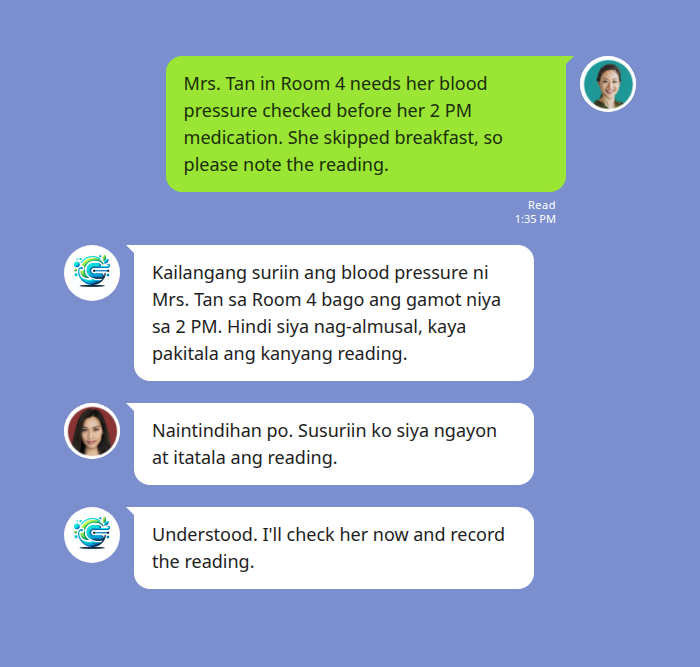
The instruction and the aide’s confirmation both stay in the thread, each person reading and writing in their own language. The charge nurse never has to wonder whether “before her 2 PM medication” was understood — the confirmation comes back, translated, in seconds.
A single group supports 2 to 5 languages at once, so a floor running English, Tagalog, and Vietnamese can all share one coordination thread rather than three siloed ones. The bot covers 180+ languages, so adding a Bahasa Indonesia or Thai aide later is a one-line change, not a new tool.
Voice notes for hands-busy care work
Care work is physical. An aide turning a resident, changing a dressing, or helping someone to the bathroom can’t stop to type a careful sentence in a second language. This is where voice matters.
A staff member can send a normal LINE voice note in their own language, and the bot posts back the transcription plus the translation as text — so the nurse reads it inline while the aide keeps working.
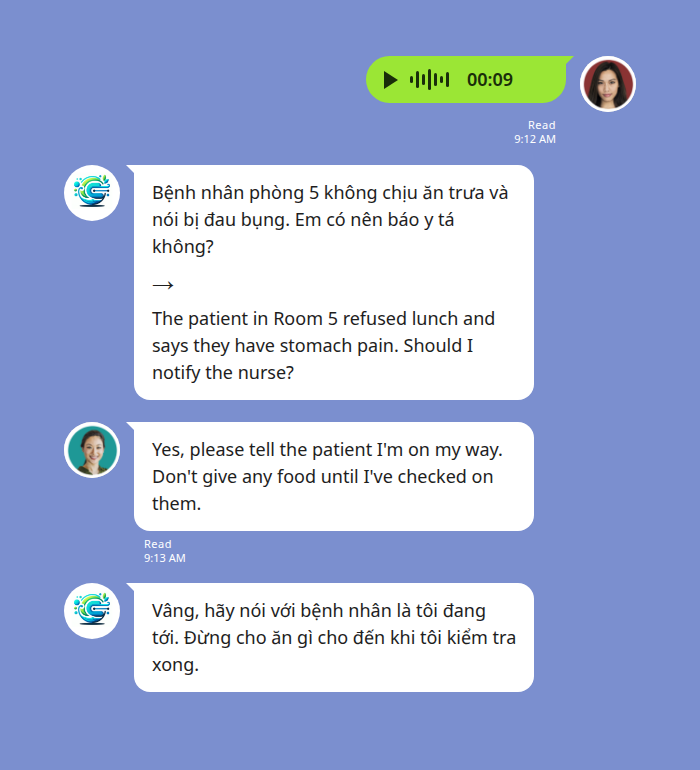
The translation typically arrives in 3 to 8 seconds — conversational pace — and the original voice note stays in the thread, so nothing is lost. One practical caveat worth knowing in a clinical setting: heavy background noise (alarms, equipment, a busy day room) can reduce transcription accuracy, so for the most safety-critical details a short text confirmation is still good practice.
A shared, reviewable record for safety-critical handovers
Because the conversation happens in one group thread — not in each person’s private translation app — the translated exchange is the record. When a morning review needs to confirm what was communicated about a resident, the thread shows the instruction, the translation every team member saw, and the confirmation, all timestamped.
That reviewability is also a safeguard for the staff themselves: an aide who reported a change can point to the exact message and time. For facilities handling sensitive resident information, see the privacy policy for data-handling specifics.
An important boundary: Echonora is the day-to-day coordination layer for your care team — handovers, observations, task prompts, and family requests. It is not a substitute for a certified medical interpreter. Formal clinical consent, admission interviews, diagnosis discussions, and legal-medical records should always go through a qualified interpreter. Use Echonora for the hundred small operational messages a shift; use a professional interpreter for the formal clinical record.
Setting it up in your facility’s LINE group
- Add the Echonora bot to your existing staff LINE group.
- Activate the languages your team uses. The English command form is simply the language names joined with “and”:
@Echonora english and tagalog and vietnameseFrom the next message on, everything posted in the group is translated for every configured language.
You can validate it on one floor first: the free plan gives you 20 messages a day, no credit card, no expiry — enough to prove it on a single shift before rolling it across the facility. When a floor’s daily volume outgrows that, the Monthly or Annual plan unlocks unlimited translation, and because the unlimited benefit covers every group a subscriber is in, you don’t need a paid account for every staff member. Current pricing is on echonora.com.
This post is part of our broader guide to LINE translation for workplace teams.
Start Using Echonora — Break Language Barriers
180+ languages, real-time text and voice translation right inside the LINE group your care team already uses
Frequently asked questions
Does Echonora replace a professional medical interpreter? No. Echonora handles everyday staff coordination — handovers, observations, task instructions, and family requests. Formal clinical consent, diagnosis discussions, and legal-medical records should always go through a certified interpreter.
Can it translate voice messages from aides who are mid-task? Yes. Staff can send a standard LINE voice note in their own language; the bot posts back the transcription and translation as text, usually within 3–8 seconds. Background noise in clinical areas can affect accuracy, so confirm the most critical details in text.
How many languages can one staff group use at once? Between 2 and 5 languages in a single LINE group, covering English plus the first languages of your care aides. Echonora supports 180+ languages overall.
Do we have to install a new app for staff? No. Echonora works inside the LINE group your team already uses — there’s no separate app to learn, which matters for staff who are already stretched.
Keep your whole care team on the same page
Try Echonora free on one floor — 20 messages a day, no credit card, no expiry